











Over the last ten years, we’ve had the opportunity to see how reading provision works in a huge range of settings. During that time, we’ve learnt that while there are key actions for successful reading provision, developing reading is bespoke to the setting, school community and learners. We have found that what matters most is creating the conditions in which every child can develop a personal and positive relationship with reading, whatever form that may take.
The UK National Year of Reading brings renewed attention to the importance of reading, offering schools the opportunity not only to celebrate its value, but to reflect on how effectively their approaches are supporting every child and young person to become a confident and engaged reader.
Findings from the National Literacy Trust’s latest research offers encouragement, whilst also highlighting areas that warrant further reflection. Its 2026 Annual Literacy Survey found that 36.1% of children and young people aged 5–18 reported enjoying reading in their free time. Although there is still room for improvement, this figure represents a positive increase from 32.7% in 2025 and marks the first rise in reading enjoyment since 2021.
The research continues to reinforce the well-established benefits of reading regularly, with enjoyment associated with higher rates of learning, relaxation, wellbeing and understanding ourselves and others.
The challenge for schools, therefore, is not simply to make reading more visible for the duration of a 12-month national campaign. It is to consider what it takes to establish a sustainable culture in which reading is valued, taught effectively and made accessible to every pupil.
At One Education, our experience of the Reading Award has given us the opportunity to explore that question with schools across the sector. Over 150 schools have now completed the One Education Reading Award, which has developed over time to support both primary and secondary settings, including schools working specifically with pupils with special educational needs.
This experience gives us a unique opportunity to reflect on what we have learned and what it tells us about developing reading in schools. Perhaps the most important lesson is that the value of a reading award lies not simply in achieving accreditation. Its greater value is in the professional learning, evaluation and improvement that take place throughout the journey.
A research-led approach: what have we learned from 150 schools?
The schools undertaking the Reading Award have made progress from a range of starting points, with priorities shaped by their individual contexts. For some, the focus is early reading and phonics; for others, comprehension, vocabulary, fluency or reading for pleasure. Others are reviewing how curriculum, resources and interventions can better meet the needs of particular groups of pupils.
This variation reflects an important principle of research-informed practice: evidence does not provide a single prescription for every school. Research must be considered alongside professional expertise and an understanding of pupils’ individual needs, particularly where children face additional barriers to reading.
The Reading Award provides a structured framework for schools to apply this approach: examining existing practice, engaging with current research, identifying priorities and evaluating the impact of change. At higher levels, the award places particular emphasis on applying research to practice, alongside ongoing evaluation, professional development and peer coaching.
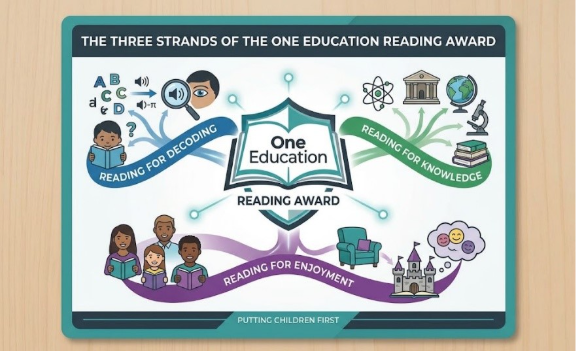
In this way, the award supports a continuous cycle of improvement, where research informs reflection, reflection informs action, and evidence of impact shapes the next steps. The accreditation recognises this work, but the professional learning and sustained improvement it supports are arguably its most significant outcomes.
How do we ensure an inclusive reading approach?
As we consider the development of our award, it is clear that strong foundations in phonics and decoding remain fundamental, however they represent only part of the journey. As pupils progress through school, they need opportunities to develop fluency, vocabulary, background knowledge and comprehension, alongside the ability to engage critically with different forms of text. They also need to encounter a sufficiently broad range of literature and reading material to develop their knowledge, interests and confidence as readers.
For schools supporting pupils with SEND, this holistic approach is particularly significant. Developing reading cannot always mean applying the same approaches, resources or expectations to every learner. Schools may need to consider accessibility, communication needs, sensory preferences, motivation, prior experiences of reading and individual barriers to progress. Appropriate scaffolding, multisensory approaches, targeted intervention and carefully selected texts can all have a role to play.
The most effective approaches begin with understanding each individual reader rather than assuming that every reader will respond in the same way.
How is reading for pleasure paramount?
One of the most important shifts in our understanding of reading is the recognition that reading for pleasure should not be regarded as separate from the teaching of reading. Research from the OECD and longitudinal academic studies has consistently identified associations between reading for pleasure, reading engagement and a range of educational, cognitive and wellbeing outcomes for children and young people (OECD, 2021; Sullivan & Brown, 2015; Mak & Fancourt, 2020; Sun et al., 2023; Sirisena et al., 2025).
Supporting pupils’ enjoyment of reading may involve providing access to a diverse range of texts, giving pupils meaningful choice, creating opportunities for discussion and recommendation, creating time to read, and helping children discover that reading extends beyond traditional notions of what constitutes a “book”.
It may also mean thinking carefully about the pupils who do not yet identify as readers. Comics, graphic novels, magazines, digital texts, newspapers, subject-specific materials and texts connected to individual interests can all provide valuable routes into reading. The Reading Award criteria explicitly recognises the importance of engaging resources, including different formats and texts that can support older or reluctant readers.
Watch our FREE webinars on developing reading, including reader identities and representation, alongside putting pupil voice at the heart of your curriculum to find out ensuring pupils access the right reading resources.
National Year of Reading 2026: A webinar that explores best practice in developing reading with a focus on diversity and representation.
Pupil Voice in Your Reading Curriculum: A webinar that explains how to put pupil voice at the heart of your reading curriculum.
What does a sustainable reading culture look like?
Our experience suggests that a sustainable reading culture is rarely created by one initiative. Instead, it develops through a combination of consistent practice and a shared understanding across the school community.
Reading needs to be visible in the environment, but it also needs to be evident in conversations between staff and pupils. It needs to be reflected in curriculum planning, professional development and resource choices. Parents and families can play an important role, while pupil voice can help schools understand which approaches are genuinely engaging their readers.
Leadership is equally important. Sustainable change requires leaders to evaluate provision, understand the evidence, support staff development and maintain reading as a strategic priority rather than allowing it to become dependent on the enthusiasm of one individual.
Within the award criteria for Reading for Enjoyment, schools are asked to consider how reading is embedded within whole-school policy and culture, how staff model positive reading behaviours, how pupil voice informs provision and how schools evaluate barriers and priorities for different groups.
This is perhaps the clearest distinction between a reading initiative and a reading culture, whereby an initiative can generate enthusiasm. A culture creates the conditions for that enthusiasm to continue.
Taking the time to understand the underlying motivations for reading advancement within your school or setting can help to ensure that reading outcomes are purposeful and long-lasting, not limited to promotional, short-term activity.
The value of the Reading Award: A case study
One school that illustrates this particularly well is The District Church of England Primary School in Newton-le-Willows.
The school had already established a strong reading culture when it began its One Education Reading Award journey. Its approach was deliberately focused on finding the right “hook” for every child, recognising that different pupils might be motivated by different types of reading and different interests.
Reading was made highly visible throughout the school, with whole-school events and family activities designed to create positive experiences around books. Importantly, the school found that the impact of its Year of Reading extended beyond the original project, becoming part of the wider culture of the school.
The Reading Award then provided a framework through which the school could continue to develop that work, including consideration of reading for decoding and reading for understanding, alongside its established emphasis on reading for pleasure.
Read more about The District School in their case study.
What might schools take forward from the National Year of Reading?
As we draw closer to completing the National Year of Reading, schools who have engaged with the valuable resources and guidance should take the time to consider what they want their reading culture to look like beyond 2026.
Schools might ask themselves:
- How effectively are we developing reading from early decoding through to fluent, confident comprehension?
- How well do we understand the barriers individual pupils experience?
- Are our approaches sufficiently responsive to pupils with SEND and other additional needs?
- Are we using research to inform decisions, rather than simply referencing it?
- Do our assessment and intervention approaches enable us to identify and respond to gaps quickly?
- Do pupils have genuine opportunities to develop positive identities as readers?
- Are we providing the range of texts, formats and experiences needed to engage different readers and are we listening to pupil voice?
- How effectively are we involving staff, pupils, families and the wider community in developing a culture of reading?
The knowledge and understanding of what constitutes excellent reading practice must not be lost once the campaign is complete. Instead, it should be reflected upon to sustain the key messages and teaching provided. It is a prudent time for schools to evaluate and further develop their practice. Taking on the Reading Award at this time might also be a perfect next step to offer the guidance and structure required to further enhance reading development!
As we can see, the value of the Reading Award lies in the process of professional reflection and improvement as well as the accountability and recognition it brings. It provides a structured opportunity to examine existing practice, develop a shared understanding of what supports children and young people as readers, and identify areas for change.
In this way, the Award is not simply about celebrating what a setting is already doing, but providing a framework that considers how a school’s reading provision should continue to develop in response to the needs, interests and experiences of its readers.
As we look towards the next 150 schools and beyond, that remains our ambition: not simply to help schools develop better reading provision, but to support them in creating the conditions in which every pupil, including those who face the greatest barriers, can have the opportunity to become a confident and engaged reader by reading their own way.
Developing reading at your setting
More information about the One Education Reading Award and developing reading practice across the school can be found on our website. We also offer a wealth of resources, support and training based on current best practice. Find out more here.
If you would like to know more, please email alice.pepper@oneeducation.co.uk or fill out the contact form below to get in touch.