




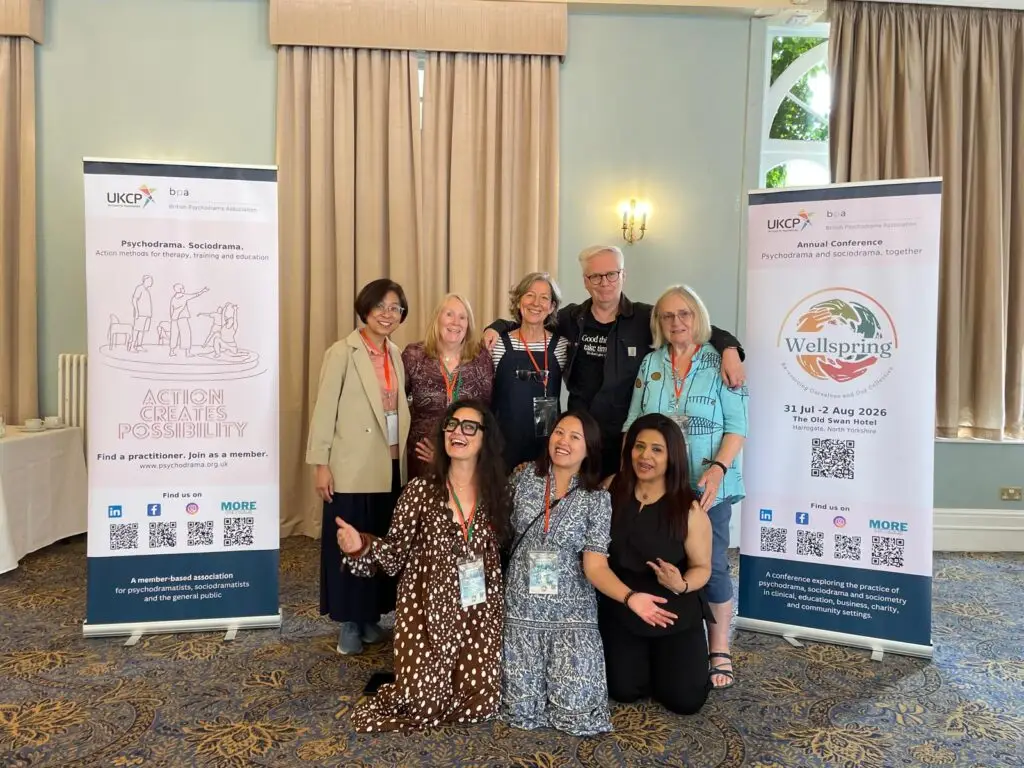







I arrived at this year’s British Psychodrama Association Conference expecting to co-chair it.
I had spent months preparing alongside my co-chair and our wonderful conference committee. There had been meetings, spreadsheets, workshop submissions, room allocations, dietary requirements, entertainment, emails and all the hundreds of small things that sit invisibly behind an event.
I had stepped into the role partly because I wanted to learn. My Co-Chair, Val, knew the ropes, and I was looking forward to standing alongside her.
Then, immediately before the conference, she experienced a family bereavement and needed to leave.
Suddenly, I wasn’t standing alongside someone who knew how to do it.
I was standing at the front.
The scaffolding we don’t always see
What struck me most was that I wasn’t actually standing there alone.
Months of working together had created something around me.
Val’s thinking was still present. The committee knew what needed doing. Volunteers stepped forward. People quietly picked things up without waiting to be asked. At moments when things became difficult, someone seemed to appear beside me.
It made me think differently about leadership.
We sometimes imagine leadership as the person standing at the front: the person with the microphone, making decisions and apparently knowing what happens next. But my experience was almost the opposite.
I could stand at the front because there was a collective behind and alongside me.
That feels important in my everyday work too. Good leadership isn’t necessarily about becoming increasingly indispensable. Perhaps it is about creating enough trust, structure and shared ownership that when something unexpected happens, other people can step forward.
When things don’t go perfectly
And, of course, things didn’t go perfectly.
There were difficulties with food, rooms and equipment. People had different needs and expectations. Most responded with enormous flexibility and kindness; occasionally disappointment became anxiety or anger.
Holding this made me think about the emotional labour involved in leadership.
People often meet the person who is trying to solve the problem at precisely the moment when they are most frustrated by it. The person standing in front of them can easily become the representative of everything that has gone wrong, even when they didn’t cause it and have limited power to change it.
That doesn’t mean we shouldn’t complain or advocate for ourselves.
But it left me with a question I have carried home:
How do we communicate what we need while remembering the humanity of the person receiving it?
That feels relevant far beyond conferences.
Sometimes resilience means allowing ourselves to feel
The conference theme was Wellspring: Re-sourcing Ourselves and Our Collective, and somewhere along the way I realised that I needed the conference to resource me too.
So, I attended a workshop that slowed everything down. For a couple of hours, I wasn’t organising, chairing, sorting something out or thinking about what needed to happen next.
And something unexpected surfaced.
I realised that this wasn’t the first time in my life that sudden grief had coincided with needing to step forward and take responsibility. There was sadness in recognising that. My instinct often tells me to keep functioning. To do what needs doing and process the feelings later. But this time, I allowed myself to feel them.
Rather than making me less able to continue, something quite different happened.
I felt more able.
The sadness moved rather than becoming something I had to carry rigidly inside myself.
It reminded me that resilience isn’t always about being strong enough not to be affected. Sometimes resilience comes from allowing ourselves to be affected and discovering that we can remain standing.
We don’t have to take everything from the table
There was another learning too.
We had been overwhelmed by the generosity of people wanting to contribute workshops. The programme was rich – perhaps overwhelmingly so for some. Some participants loved the choice. Others felt there was simply too much.
I found myself thinking about our responsibility for regulating ourselves.
Perhaps a rich programme is a smorgasbord rather than a prescription. We don’t have to eat everything.
Sometimes what resources us is another workshop. Sometimes it is sitting with somebody over coffee. Sometimes it is going for a walk. Sometimes it is dancing. And sometimes it is recognising that we have had enough and going to bed.
I think the same is true of working life.
Being committed doesn’t require us to say yes to everything available to us.
Play matters too
Some of my strongest memories aren’t of the serious moments.
They are of people laughing as a crime drama unexpectedly unfolded around the Gala Dinner; actors planted amongst unsuspecting tables; celebrating new writing within our profession; and watching a dance floor fill as a band played.
At the end of the conference, Playback Theatre gave people an opportunity to offer experiences from the weekend and see them compassionately reflected back through action.
There was something profoundly human about moving between all these states, thinking, learning, grieving, playing, laughing, dancing and reflecting.
For those of us who work alongside distress, trauma and complexity, perhaps play isn’t an optional extra.
Joy is a resource too.
Learning to receive
There was one final piece of learning that surprised me.
People were very kind about how I had chaired the conference. And I discovered how difficult I find receiving that.
My instinct is to say that it wasn’t me, it was everybody. And of course that is true. The conference existed because of an extraordinary collective effort. But I began thinking about whether acknowledging our own contribution necessarily diminishes anyone else’s.
I love celebrating other people’s achievements. Perhaps part of maturity is learning to allow other people to celebrate ours.
There may be a kind of grace in simply saying: Thank you. I’m glad what I did mattered.
I am still practising that one.
Replenishing the well
I came home tired, but strangely replenished. The conference reminded me that none of us has an inexhaustible internal well from which we endlessly give to other people.
We replenish one another.
Sometimes we lead. Sometimes we follow. Sometimes we need somebody else to hold the frame. Sometimes we are the person who quietly notices what needs doing.
And sometimes we simply need permission to stop.
Perhaps that is what Wellspring ultimately came to mean for me.
We gather around the well. Sometimes we draw from it. Sometimes we replenish it. And sometimes we simply sit beside someone who is thirsty.
None of us needs to be the well on our own.
For further reflections on leadership, wellbeing and inclusion, visit our blog page here.