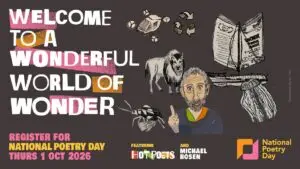



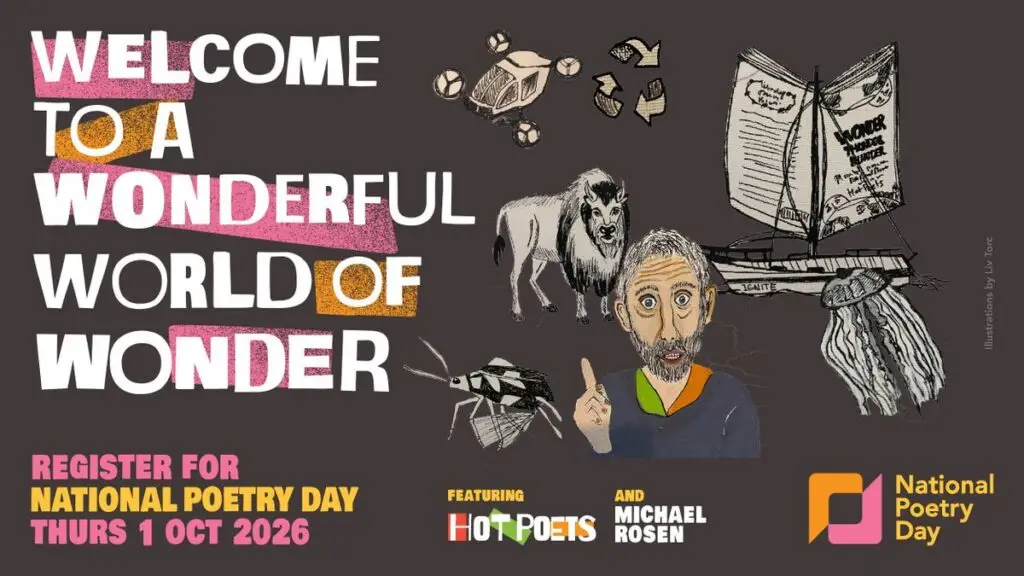

Thursday, 1 October 2026 marks National Poetry Day, the UK’s biggest mass celebration of poetry. Around 1.5 million people take part each year, coming together to read, perform and listen to poetry, and even write some of their own.
This year’s theme is Wonder, reflecting poetry’s unique ability to reveal the extraordinary in the small moments of everyday life. Whether it’s autumn leaves, birds singing in the garden, or an old pair of shoes, poetry can take something familiar and make it feel brand new.
For children, poetry’s playful use of language can be particularly powerful, encouraging them to look more closely at the world around them, ask questions and make connections. Yet, more than half (51.2%) of children and young people don’t engage with poetry at all. When asked why, children often describe poetry as boring, or say that it does not reflect their interests. But perhaps these responses tell us less about poetry itself, and more about the opportunities children have to experience it.
What are the barriers to teaching poetry?
Research suggests that children actually respond very positively when they do encounter poetry: primary school teachers report that children enjoy hearing, writing and performing poems. However, poetry is read aloud less than once a week in 93% of schools. So what is standing in the way?
Teachers identify a number of barriers, including their own knowledge and confidence, as well as a wider perception among school leaders and other staff that poetry is less important than other areas of the curriculum. More than six in ten teachers report that they have never received CPD or training focused on poetry. It is unsurprising, then, that when asked to name children’s poets, many teachers named those they had encountered during their own schooling.
This is significant because our own experiences of poetry inevitably shape the experiences we create for children. If we let engagement with poetry continue to decline, there is a risk that this pattern continues from one generation to the next. As a result, poetry becomes less familiar, increasingly seen as old-fashioned and out of touch with modern life. But poetry remains just as relevant to children today as ever, offering rich opportunities to develop language, literacy, curiosity and understanding of the world.
What are the benefits of poetry for children?
We know that reading plays a fundamental role in childhood development. But poetry – including nursery rhymes, songs and traditional verses – offers particularly valuable opportunities for children to develop the knowledge and skills they need to make sense of the world around them.
Poetry makes every word count. It plays with sounds, rhythm, repetition, vocabulary and meaning, encouraging children to listen closely and pay attention to how language works. Over time, these experiences can help to lay the essential foundations for children’s literacy:
- Phonological awareness
Phonological awareness is the ability to notice and think about the sound structure of spoken language, including rhyme, syllables, individual sounds and patterns within words.
Poems and nursery rhymes give children repeated opportunities to hear and recognise these patterns, helping them understand that words can rhyme, be broken into parts and changed by altering a sound. This awareness provides an important foundation for learning to read, as children begin to connect the sound they hear with the letters and words they see on the page.
- Vocabulary
Poetry gives children access to a particularly rich range of language, introducing words, phrases and expressions they may not encounter in everyday conversation. Traditional rhymes can offer unfamiliar or old-fashioned language, while contemporary poetry can introduce precise, descriptive and imaginative vocabulary.
Hearing new words repeatedly, in different contexts and through meaningful discussion, helps children develop a deeper understanding of their meanings. This gives them a richer bank of language to draw on when speaking, reading and writing.
- Background knowledge
Poetry can also help children build background knowledge – what they know about people, places, experiences, traditions and the wider world. For example, a poem about autumn might introduce changing seasons, falling leaves and migrating animals, giving children knowledge they can draw on when they encounter these ideas elsewhere.
Understanding what we read depends on more than knowing the words on the page; children also need knowledge to make sense of them. The more they know about the world, the more easily they can make connections and understand increasingly complex texts.
Ideas and activities to celebrate poetry
National Poetry Day is the perfect opportunity to put poetry centre stage and celebrate all it has to offer. But the joy of poetry shouldn’t be limited to one day. The following ideas and activities can help make poetry a regular part of classroom life, giving children the freedom to explore, perform and play with language throughout the year.
- Experience poetry
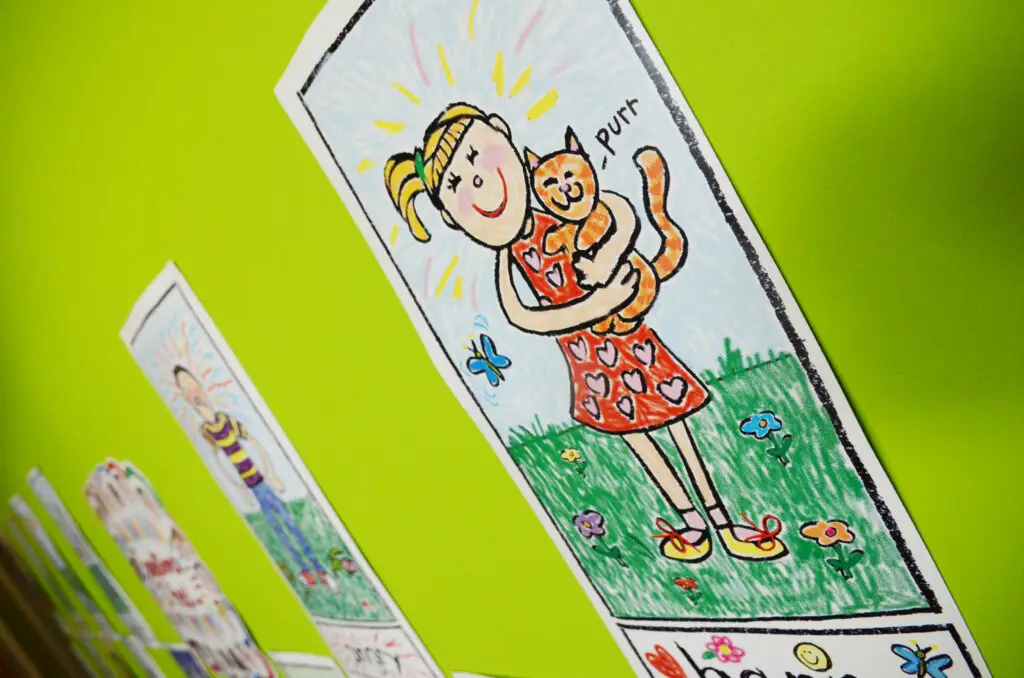
Take the pressure off writing and simply take the time to experience poetry together. Start by sharing poems by different poets, exploring different styles and forms, and ask children to talk about the features that stand out. This allows them to appreciate the diversity of poetry and take inspiration from real-life poets. A fun activity to try in the classroom is “poetry papering,” where selected poems are put on display and children are allowed to wander, read and respond to the ones that catch their attention. An easy way to spark curiosity and show children there is more than one way to experience a poem!
- React to poetry
We should remember that it is sometimes fine to dislike what we read as much as like it. Creating opportunities to experience the huge wealth of poetry forms gives pupils the chance to favour certain poetry styles over others which will also lead to them experimenting with these styles themselves.
Try out our free poetry resource to develop poetry preferences through oracy.
- Find poetry everywhere
Poetry doesn’t have to sit apart from the rest of the curriculum. Look for poems that connect with what children are already learning, whether it’s a poem about the anatomy of a plant, or the adventures of the Vikings. A poem allows children to revisit prior learning, explore a new topic, or consider another point of view. Better yet, creating a poem together can be an excellent way to cement pupils’ understanding of a concept by giving them time to reflect, reinforce and recreate what they’ve learned.
- Bring poems to life
Poetry has a musical quality that can be lost when it stays on the page. By encouraging children to perform poetry, they can experiment with voice, rhythm, intonation and prosody to change the way a poem feels. Organise a class performance, group reading or whole-school assembly around a certain theme or topic to showcase the wide range of poetry that children can engage with.
- Meet a poet
Meeting the person behind the words can help to turn a poem on the page into something much more personal. Invite a poet into school or connect with poets through online performances, workshops and Q&As. Seeing how poets experiment with language, play with conventions and write without fear of “getting it wrong” can quickly ignite children’s creativity and inspire them to see themselves as writers.
- Make poetry a part of everyday life
The more children encounter poetry, the more familiar and enjoyable it becomes. Keep poetry within easy reach, whether that’s a collection on the classroom shelf or a well-stocked school library, and make time to share a poem at the start of the day or during a regular read-aloud. Give children the chance to encounter poetry in all its variety: different voices, cultures, forms, subjects and styles. Whether the subject is entirely new or wonderfully familiar, poetry has a way of making us look at things differently. That sense of discovery is where poetry and wonder meet.
This may also be the perfect time to audit your poetry resources in school. Our partner, Peters has an excellent range of poetry book packs which include many must-have titles for any school. Some of our personal favourites at the moment include:
| EYFS | A Great Big Cuddle by Michel Rosen All I Hope for You by Kate Thompson Blow a Kiss, Catch a Kiss by Joseph Coelho Caterpillar Cake by Matt Goodfellow and Krina Patel-Sage Nature Trail by Benjamin Zephaniah and Nila Aye The City Sings Green by Erica Silverman Tree Whispers by Mandy Ross and Juliana Oakley We Sang Across the Sea by Benjamin Zephaniah and Onyinye Iwu |
| KS1 | A First Book of the Sea by Nicola Davies and Emily Sutton A Songbird Dreams of Singing by Kate Hosford and Jennifer M Potter A Whale of a Time by Matt Hunt and Lou Peacock Home by Isabelle Simler Poems Aloud by Joseph Coelho and Daniel Gray-Barnett Poems Out Loud! By Laurie Stansfield The Star Whale by Nicola Davies and Petr Horacek Together: Animal Partnerships in the Wild by Isabel Otter and Clover Robin Zim, Zam, Zoom by James Carter and Nicola Colton |
| LKS2 | A World Full of Poems by Sonny Ross Courage Out Loud by Joseph Coelho and Daniel Gray-Barnett Coyote’s Soundbite by John Agard and Piet Grobler I am the Seed that Grew the Tree by Fiona Waters and Frann Preston-Gannon My Heart was a Tree by Michael Morpurgo and Yuval Zommer Our Earth is a Poem Smile out Loud by Joseph Coelho and Daniel Gray-Barnett The Big Amazing Poetry Book by Chris Riddell When Poems Fall from the Sky by Zaro Weil and Junli Song |
| UKS2 | A Caribbean Dozen by John Agard and Grace Nichols And Everything will be Glad to See You by Anna Shepeta and Ella Risbridger An Emotional Menagerie by Rachel Saunders Being You: Poems of Positivity by Daniel Thompson and Julia Murray Out There in the Wild by Nicola Davies, James Carter and Dom Conlon Stars with Flaming Tails by Valerie Bloom and Ken Wilson-Max The Final Year by Matt Goodfellow The Lost Spells by Robert MacFarlane and Jackie Morris |
| KS3 & KS4 | A Change is Gonna Come Clouds Cannot Cover Us by Jay Hulme Everything All at Once by Steven Camden Hey, Girl! By Rachel Rooney and Milo Hartnoll Poems to Live Your Life By Chris Riddell SLAM!: You’re Gonna Wanna Hear This The Black Flamingo by Dean Atta and Anshika Khullar The Crossing by Manjeet Mann The Curious Case of Karl Nova by Karl Nova The Dark Lady by Akala The Girl Who Became a Tree by Joseph Coelho and Kate Milner |
Upcoming events
There are plenty of ways to experience the wonder of poetry beyond the classroom. With poetry celebrations and events taking place across the country, there are lots of ways for people to discover, share and enjoy poetry together.
- A Live Poetry Assembly with Michael Rosen Thursday, 1 October 2026
Join one of the UK’s best-loved children’s poets, Michael Rosen, alongside Hot Poets Liv Torc and Chris Redmond and two brilliant Young Poet Laureates, for 30 minutes of performance, conversation, poetry and participation.
- Remembrance National Assembly Wednesday, 11 November 2026
The Remembrance Assembly will include a panel of authors from a range of experiences and backgrounds, using their unique voices to highlight how reading brings people together into the Remembrance community.
- Young Poets Week 2026 Monday, 2 – Friday, 6 November 2026
Celebrate Young Poets Week 2026 with free poetry resources and online masterclasses for students and teachers.
You can also engage with excellent free resources through the National Poetry Day website.
National Poetry Day is a chance to celebrate what poetry brings to children’s lives: wonder, language, imagination, and a deeper understanding of the world. But its value extends far beyond a single day. By making poetry part of everyday life in school, we can help children become confident readers and curious learners.
If you would like support developing poetry in your school or any other aspect of literacy, please contact Alice.Pepper@oneeducation.co.uk.