
















Performance management can often be perceived as a compliance task, something schools and trusts have to do to meet regulatory requirements. However, when approached strategically, it can transform into a powerful tool for leadership development and for driving systematic change where needed.
Effective performance management goes beyond checklists and paperwork; it becomes an ongoing process that aligns with a school or trust’s vision and core values. By focusing on clear goals, continuous feedback and professional growth, it empowers leaders to not only enhance their own leadership but to also inspire and drive positive change throughout the entire school or trust.
Key to the success is to root the process in the school’s vision and values. At One Education, we pride ourselves in helping school and academy leaders thrive and their community flourish through performance management. So what does that actually look like in practice?
Throughout this blog, we use examples to highlight how a well-defined school vision provides the strategic foundation for decision-making at every level of the organisation. Rather than existing as a statement of intent, the vision actively shapes long-term planning, leadership accountability and professional learning. This approach can easily be transferred to working across whole trusts too, with individual school’s plans stemming from whole trust vision and strategic plans.
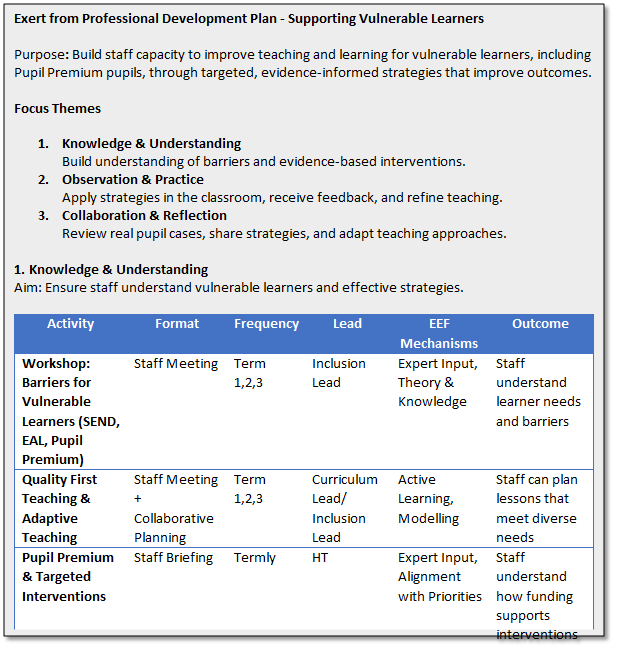
Using the priority of improving outcomes for disadvantaged pupils as an example, we can see how it informs key decisions rather than sitting as a separate workstream. This ensures that leadership actions, improvement priorities and staff development are all deliberately connected and focused on securing better outcomes for those pupils who need it most. In this case, the focus on pupil premium can be tracked from the vision, leading into the five-year strategic plan through to the School Development Plan, Headteacher Performance Management (HTPM) objectives, wider appraisal processes and targeted CPD. While this blog explores just one priority, the same disciplined approach underpins the implementation of the wider strategic plan.
Step 1 – Starting with the Vision and Values
Before we review data, discuss progress from the previous year or set new objectives, we spend time understanding not only the school but the headteacher’s ultimate vision for the school or trust. What is the school striving to achieve and which core values underpin and guide every aspect of its work? Finally, what does success look like for the school’s pupils and community? Delving into this first means that the vision and values are not simply opening phrases on a policy document but instead an anchor for everything that follows.
By making the school or trust’s vision and values the central focus, the appraisal process becomes a meaningful, reflective experience that drives real impact. We take the time to understand the unique context of each school, from its culture to the specific challenges it faces. This allows us to tailor performance management strategies that align directly with the school’s improvement plans, ensuring that leadership targets are relevant, practical and rooted in the everyday realities of the school or trust environment.
Step 2 – Continuing the Vision
Quite simply put, the vision allows opportunity to clarify the destination for the school. This is underpinned by the Development Plan, which sets out the route. At One Education, we ensure the appraisal process aligns with and supports the school or trust’s vision rather than becoming a competing document that adds to the headteacher’s workload. As such, the appraisal process aims to sharpen leadership focus to ensure vision can be met. For example:

| 5 Year Strategic Plan | |||||
| Vision | Every child, regardless of background, achieves their full potential through high-quality education, inclusive learning environments and strong community partnerships. | ||||
| Strategic Priorities | Quality Pedagogical Approaches | Support for Vulnerable Learners | Curriculum Enhancement & Enrichment | Inclusive Learning Environment | Community and Stakeholder Engagement |

The priorities remain consistent across the five year period, with the annual School Development Plan building strategically towards the implementation of the vision and strategy.
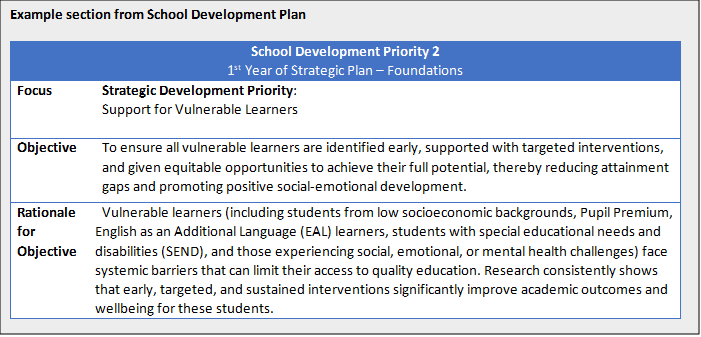
Step 3 – The Meeting
On the day of the review meeting, the process begins with an update on the current school or trust context and significant factors. We then guide you through a structured reflection on the previous year.
Together, we review the evidence against the objectives set in the previous cycle. This provides an opportunity for professional dialogue, grounded in impact rather than activity. The conversation then moves into context-setting, exploring what has changed over the past year, such as staffing, cohort needs, inspection outcomes, safeguarding priorities or budget pressures and identifying the key risks and opportunities ahead.
From this, we will begin to shape potential objectives for the coming year. These will be closely aligned with the School Development Plan priorities, as well as the headteacher’s own professional development needs. When setting objectives for performance management, it’s crucial to keep them focused and high-impact. By aligning these objectives directly with the school’s improvement priorities and pupil outcomes, we ensure that leadership efforts are working toward measurable, meaningful progress. Clear success criteria and key actions will be agreed to ensure focus and accountability. This typically lasts around an hour, and all objectives will be aligned with the Headteachers’ Standards (October 2020), ensuring a consistent and robust framework for evaluation and growth.
Following the initial discussion, we will meet with the HTPM panel of governors to support a balanced and evidence-informed review of the head’s performance. Using the Headteachers’ Standards and progress against previous objectives, we help guide the conversation, ensuring governors feel confident in reaching a fair and robust judgement. Draft objectives for the year ahead are also shared and refined at this stage. For example:
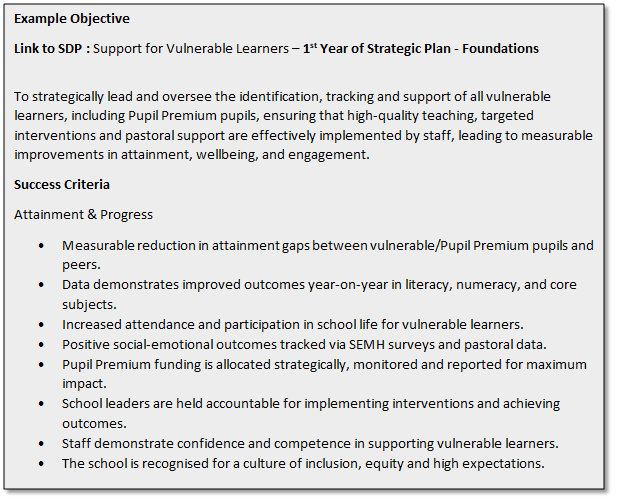
The process concludes with a joint meeting between the adviser, the panel and the headteacher. This is an opportunity to share feedback clearly and constructively, and to finalise a focused set of objectives, success criteria and key actions for the year ahead – along with any agreed professional development. This approach avoids the pitfall of excessive or fragmented targets that can dilute focus and hinder real growth.
Step 4 – The Mid-Year Review
We view objectives as dynamic, living tools that evolve over time. By reviewing and updating development plans at the mid-point in the year, we ensure that leaders are equipped with the right support and resources to drive sustained school improvement.
Example meeting
At the mid-year review, the Headteacher presented evidence of strategic oversight in supporting vulnerable learners, including Pupil Premium pupils. This included the Vulnerable Learner Tracker data, Pupil Premium expenditure reports, intervention monitoring summaries, staff professional development logs, and SEMH/wellbeing survey results.
The data shows the literacy gap reduced by 5% while the numeracy gap remains stable. This leads to discussion of how gaps are being addressed and the headteacher explains strategic allocation of interventions, leadership accountability and monitoring cycles.
The discussion provided an opportunity for strategic reflection, enabling the Headteacher and adviser to review what is working well, identify challenges, and agree on next steps and support needed to strengthen interventions in upper key stages and enhance adaptive teaching through additional coaching. Agreed next steps included refining monitoring processes, reporting to governors on Pupil Premium impact, and exploring further community partnerships to support SEMH programmes.
The midpoint of the cycle is not simply a check on progress, but a chance to adapt and respond to the reality of the school year. It provides an opportunity to reflect on whether the original priorities remain the right ones, whether any significant changes have occurred, and whether the headteacher may need different or additional support. For example, a shift in staffing or the emergence of a new safeguarding priority may require objectives to be adjusted. This should not be seen as a failure, but as a sign of responsive and effective leadership.
Cascading Objectives and Appraisals Across Staff
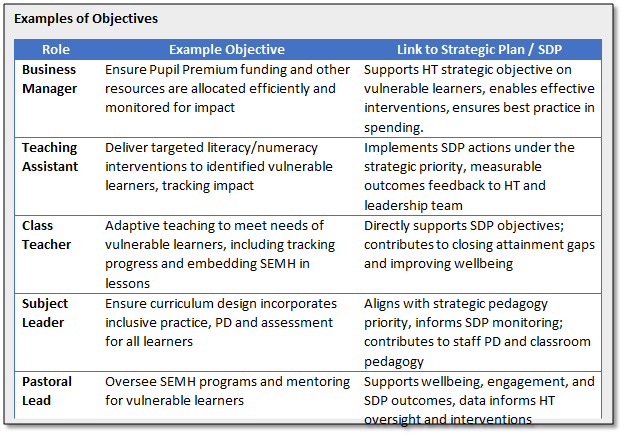
All staff objectives should align with the SDP and strategic plan, creating a coherent approach across the school or trust. All staff appraisals should reference the same strategic priorities, so objectives are coherent and mutually reinforcing. Progress for TAs, teachers, business managers and leaders is measured against contribution to SDP outcomes, rather than isolated tasks. This ensures everyone is working toward the same goals, creating a unified school or trust-wide focus on improving learning, wellbeing, and inclusion. For example:
Opportunities for Coaching and Professional Development
A coaching approach, centred on regular, reflective conversations, strengthens a leader’s ability to assess their own practice and drive improvement. By encouraging self-reflection and providing tailored feedback, coaching becomes a powerful tool for leadership development. Additionally, Professional Development should be clearly linked to the outcomes of the appraisal process, ensuring that the learning opportunities provided are both relevant and targeted. This creates a seamless connection between performance management, professional growth and the broader school improvement plan.
Next Steps
Effective performance management is not just about measuring performance, it’s about aligning a school or trust’s vision, leadership development, and CPD to create a cohesive system that supports growth at every level. It creates a clear line of sight from the school or trust’s vision through the School Development Plan, into leadership actions, and ultimately to measurable impact. When done well, it fosters a culture of continuous improvement, where leadership thrives and, in turn, positively impacts the entire school community. Strong, well-implemented performance management systems are integral to driving both leadership effectiveness and school success.
For more information on how we can support your school or academy trust with strategic support and performance please email jo.gray@oneeducation.co.uk