















Reading is the foundation upon which successful learning is built. The ability to read confidently, fluently and critically is essential across every subject area. Whether pupils are interpreting historical sources, analysing scientific explanations, solving mathematical word problems or evaluating geographical data, reading is central to accessing knowledge and demonstrating understanding.
Developing strong readers is therefore a whole-school responsibility. Reading across the curriculum recognises that every teacher has a role in supporting pupils to engage with increasingly complex texts within their subject discipline. By embedding purposeful reading opportunities throughout the curriculum, starting in Key Stage 1, schools can strengthen literacy, deepen subject knowledge and equip pupils with the skills they need for lifelong learning.
Why reading across the curriculum matters
The demands placed on pupils’ reading increase significantly as they progress through school. Subject-specific vocabulary becomes more complex, sentence structures become increasingly sophisticated and texts require greater levels of inference, evaluation and critical thinking.
Strong reading skills are among the strongest predictors of academic success. The OECD describes reading literacy as “a foundation for achievement in other subject areas”, emphasising that pupils who can confidently understand, interpret and evaluate complex texts are better equipped to access the full curriculum and succeed in education beyond school.
Pupils who struggle to access curriculum texts are often disadvantaged across multiple subjects, regardless of their understanding of the concepts being taught. Conversely, confident readers are better able to acquire new knowledge, make meaningful connections between ideas and engage more deeply with learning.
Reading should therefore not be viewed as an isolated literacy initiative but as an integral part of curriculum design throughout all school phases. Every subject offers unique opportunities to develop reading skills while simultaneously enhancing disciplinary knowledge and acting as a model for disciplinary writing expectations if texts are chosen wisely.
Reading interaction across the disciplines
One of the most important principles of disciplinary literacy is recognising that experts read differently depending on the subject they are studying. Historians question the reliability of sources, scientists evaluate evidence, geographers interpret maps and data, while mathematicians decode precise language to solve problems.
Teaching pupils these subject-specific approaches to reading helps them become more independent learners. Rather than simply asking pupils to read a text, teachers can explicitly model how experts think while reading.
For example:
- In history, pupils might compare contrasting historical accounts and evaluate author bias.
- In science, they may identify cause-and-effect relationships within an explanation.
- In geography, they could interpret graphs, maps and case studies alongside written information.
- In mathematics, pupils may unpick complex vocabulary within multi-step word problems before attempting calculations.
- In art or music, learners can interpret critical reviews, artists’ statements or historical contexts to deepen understanding.
By supporting pupils to use these strategies effectively when accessing disciplinary texts, we enable them to develop the skills required to learn more effectively within the subject.
Creating a responsibility for reading in every subject
Developing confident readers requires consistency across the school. Considering teacher subject knowledge around the strategies for reading required in the subject disciplines is key. With consistency of approach, pupils experience shared expectations and common strategies that reduce cognitive load and increase confidence.
Schools may choose to establish whole-school approaches to:
- Explicit vocabulary instruction
- Reading fluency
- Annotation techniques
- Retrieval practice linked to reading
- Purposeful examination of text purpose, audience and technique (including grammatical features)
- Oracy outcomes related to substantive and disciplinary knowledge and discussion around texts
- Opportunities for independent reading
Pupils will transfer skills between subjects while recognising that reading serves different purposes depending on the discipline. Reading then becomes the foundation of their learning which educators can well-develop through developing increasing independence as pupils progress through their schooling.
Supporting vocabulary development
Vocabulary knowledge is one of the strongest predictors of reading comprehension. Pupils cannot fully engage with curriculum content if they do not understand the language being used.
High-quality vocabulary instruction extends beyond displaying key words on classroom walls. Effective practice involves explicitly teaching word meanings, morphology, etymology and how vocabulary is applied within subject contexts.
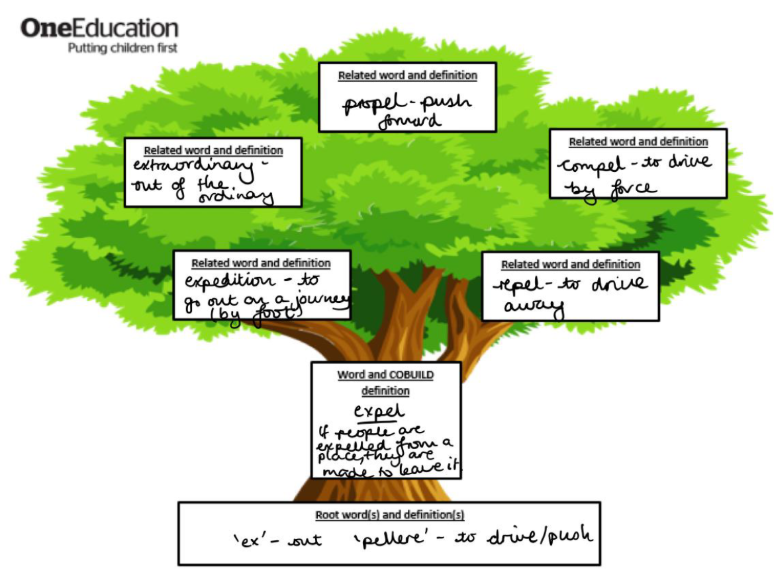
Image: The One Education Vocabulary Tree encourages pupils to explore related words building on morphological links.
Teachers might introduce new terminology before reading, revisit vocabulary through discussion and provide repeated opportunities for pupils to encounter words in different contexts. This layered approach supports long-term retention and enables pupils to use academic language confidently in both spoken and written responses.
Importantly, vocabulary instruction should be carefully sequenced across the curriculum so that pupils build increasingly sophisticated language over time.
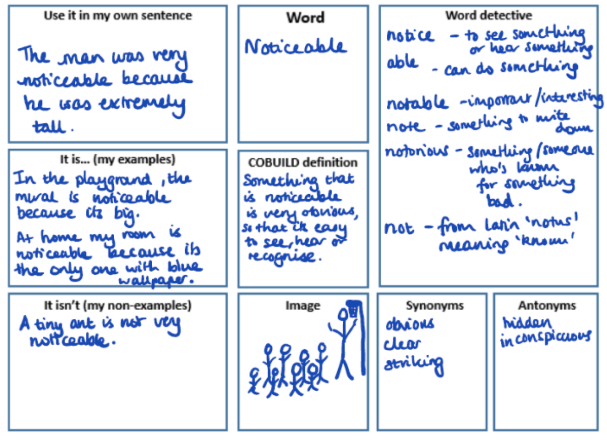
Image: One Education Vocabulary Word Map challenges pupils to gain a thorough understanding of word meaning and its application. Download yours here.
If you are considering a structured approach to effective vocabulary teaching, the One Education Vocabulary is V.I.T.A.L. approach is a whole-school framework for developing vocabulary as the foundation of reading, writing and learning across the curriculum. It encourages schools to Value vocabulary by creating a language-rich culture, Identify the key academic and subject-specific words pupils need to know, Teach vocabulary explicitly through rich, evidence-informed instruction, Apply new vocabulary through repeated opportunities to use it in speaking, reading and writing, and Learn by assessing pupils’ understanding to ensure words become embedded in their long-term memory.
Reading for meaning
Effective curriculum reading encourages pupils to actively engage with what they are reading.
Teachers can support comprehension by modelling expert thinking aloud, asking purposeful questions and encouraging pupils to summarise, predict and clarify meaning as they read then move onto evaluating, probing, analysis and drawing comparisons once information is understood.
Developing disciplinary reading skills includes providing pupils with relevant, high-quality disciplinary texts. These are texts that showcase both the grammar and the formality of the discipline e.g. textbook pages on scientific topics which include different text formats: tables, diagrams, text and data to interpret. Pupils therefore see and use texts that showcase the disciplinary skills required of the subject.
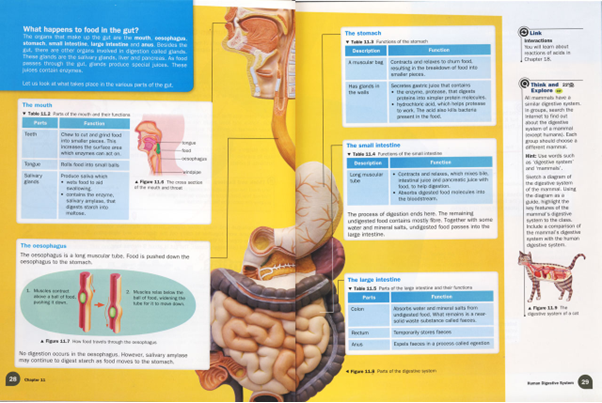
Image: Food digestion, KS3 (Science Matters, pp. 28–29 Volume B (2013). 2nd Edition Singapore: Marshall Cavendish Education.
The scientific text above illustrates the multimodal nature of reading within the discipline. Scientific understanding is often constructed through a combination of written explanations, diagrams, graphs, tables and visual representations, requiring pupils to navigate and interpret multiple forms of information simultaneously.

When selecting texts for classroom use, it is important to consider their purpose. Texts written to engage pupils or build background knowledge have an important place within the curriculum, but they should not be relied upon as models of disciplinary literacy. To help pupils understand how experts read, think and communicate within a subject, they also need regular opportunities to engage with authentic disciplinary texts that reflect the language, structures and conventions of the subject itself.

While narrative texts such as ‘Amy gets eaten’ by Adam Kay are highly effective for developing pupils’ understanding of the digestive system and serves as an engaging introduction to the Year 4 science curriculum, we must be mindful of its audience and purpose which are not to adhere to the language conventions typically associated with scientific writing where we expect to see formal subject-specific language using sequencing adverbials and modal verbs.
To develop disciplinary literacy, pupils should encounter a carefully planned range of text types within each subject. Throughout this progression, texts should remain intellectually ambitious.

Image: It Takes Guts by Jennifer Gardy is another link text that supports pupils with an engaging format, but with formal content around the topic.
Combining a range of suitable texts with explanation of their format alongside appropriate scaffolding – such as pre-teaching vocabulary, modelling reading strategies or supporting pupils to navigate complex text features – should enable all learners to access challenging material without reducing the cognitive demand of the curriculum.
To support you to identify the effectiveness of text choices, we have created this helpful resource to support teachers to appraise texts for their disciplinary quality.
Building reading stamina
As pupils move through secondary education, they are expected to read increasingly lengthy and complex texts independently. Developing reading stamina is therefore an important aspect of curriculum planning.
This does not happen overnight. Regular opportunities to engage with sustained reading across subjects help pupils become more resilient readers. Carefully selected texts that stretch pupils while remaining accessible encourage perseverance and confidence.
Schools may also consider how independent reading opportunities complement curriculum reading. A rich reading culture- supported by libraries, tutor reading, author visits and reading events- reinforces the message that reading is valued throughout the school community. Reading non-fiction for pleasure provides valuable opportunities for pupils to interact with the language of the discipline further.
Recognising excellence through the One Education Reading Award
Developing a whole-school reading culture requires strategic leadership, collaboration and sustained commitment. The One Education Reading Award, which celebrates its 10th Anniversary this year, provides schools with an opportunity to celebrate and strengthen this work by recognising effective practice in reading development.
The award encourages schools to reflect on their current provision, evaluate the impact of reading initiatives and identify opportunities for continuous improvement. Rather than focusing solely on outcomes, it supports schools in considering how reading is embedded across leadership, teaching, curriculum design and school culture.
For many schools, the award acts as a framework for developing a coherent reading strategy that places literacy at the heart of school improvement. It also provides valuable opportunities for professional dialogue, self-evaluation and sharing effective practice across staff teams.
Schools working towards the award evidence excellence in reading provision in the key areas: reading for enjoyment, reading for understanding/meaning (disciplinary reading), and reading for decoding/fluency. Together, these elements contribute to a comprehensive approach that supports every pupil in becoming a successful reader. For more information about undertaking the Award, please contact alice.pepper@oneeducation.co.uk or go to our Reading Award page.
Looking ahead
Reading across the curriculum is not an additional initiative competing for curriculum time; indeed, it is an expectation of the writing framework that disciplinary literacy be planned for withing every school’s curriculum as the responsibility of the subject leaders. After all, reading for understanding is a powerful approach that enables pupils to access the full richness of every subject. When schools prioritise reading as a shared responsibility, they create classrooms where pupils are better equipped to think critically, communicate effectively and engage confidently with increasingly complex ideas.
By embedding high-quality reading opportunities across the curriculum, explicitly teaching disciplinary literacy and fostering a strong reading culture, schools can ensure that every pupil has the opportunity to thrive.
For leaders seeking to strengthen whole-school literacy, the One Education Reading Award offers a valuable framework to evaluate existing practice, celebrate successes and plan meaningful next steps. Combined with ongoing professional learning and a commitment to reading across every subject, it can help create a sustainable culture in which reading is recognised as the gateway to achievement, curiosity and lifelong learning. Consider joining us to enhance and develop your reading provision.
To learn more about the One Education Reading Award, you can read our previous blog here.
If you have any other questions, please get in touch. A member of our Literacy Team will be happy to help!