


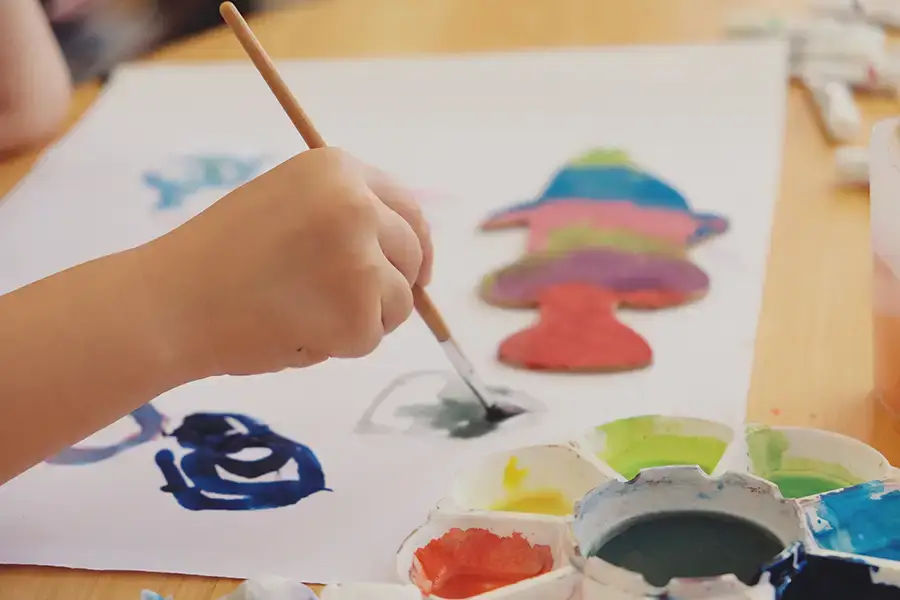





Art therapy sessions can often act as a microcosm of society, replicating many of the social attitudes, norms, and behaviours that exist in the wider world. In the calm, contained space that therapy creates, social trends become easier to examine, allowing individuals to consider how their own thoughts and behaviours are shaped by their social environments.
Observing social trends in the therapy room can also be an eye-opening experience for the Art Therapist themselves. Recently, I have noticed a shift in values relating to “rights and responsibilities,” a trend that seems to reflect our society at large with significant implications for children, parents, and professionals.
What rights are we entitled to and what are we responsible for?
Psychotherapy has taught me that a sense of entitlement – believing I am worthy of care, respect, and safety – is essential to healthy development. Bowlby’s ideas on attachment come to mind here: a child who receives consistent care develops trust in themselves and in others.
However, entitlement without responsibility can easily tip into fragility or self-centredness. Winnicott describes how responsibility emerges as children internalise their caregiver’s presence. When this goes well, it creates the possibility of saying: I matter, and you matter too.
I think about how much harder it is to hold this balance now, as poverty rates continue rising and parents are working longer hours. Additionally, the hidden work of women in the home and the strain this creates means that children are now in nursery and childcare settings for earlier and longer periods – and the growing workload is often distributed amongst already overstretched staff.
This raises questions about the security of the child’s attachment: who is holding the child’s emotional world, and how do we share that responsibility between family, professionals, and society?
Striking the right balance
When confronted with a problem, people will often turn to figures of authority for solutions. Indeed, therapists often feel a pressure to provide answers, techniques, and certainty. I know many school leaders and teachers will feel the same. Yet, what I know from both practice and from theory is that authority is not enough to put people at ease – first and foremost, safety comes from relationships.
Bion’s idea of containment feels particularly relevant: the adult receives the raw, overwhelming feelings, processes them, and gives them back in a way the child can manage. This is what I understand as positive authority – boundaries that are clear but infused with care. Think about the difference between saying “Don’t do that” and “I won’t let you hurt yourself or others.” One restricts whilst the other contains.
The importance of setting boundaries ties together with Fromm’s writing on freedom. Boundaries can require careful negotiation to avoid infringing on our sense of freedom – something which we generally consider as an uncomplicated good. But Fromm suggests that freedom without responsibility becomes narcissistic. On the other hand, responsibility without freedom becomes oppressive. I see both extremes in education today: some young people refuse responsibility altogether, others carry the weight of family stress and systemic pressure beyond what is fair for their age. How can we – as parents and as professionals – strive to find a sense of equilibrium?
The importance of giving and taking
“The good-enough [parent]… starts off with an almost complete adaptation to her infant’s needs, and as time proceeds she adapts less and less completely, gradually, according to the infant’s growing ability to deal with her failure. Her failure to adapt to every need of the child helps them adapt to external realities.”
Winnicott, DW. (1953).
Winnicott’s idea of the“good-enough parent” reminds us that no one can give endlessly – in fact, it can be against our best interests to try. Yet, our systems often demand exactly this, especially from women, as well as professionals in care and education.
The imbalance echoes what I see in environmental systems: within an interconnected network, if one part is overdrawn, the whole suffers as a result. Environmental and arts therapies rely on reciprocity; a cycle in which resources are given back as well as taken. With this in mind, I wonder how we can help children and families learn to live in a rhythm of fair exchange, rather than depletion?
Final thoughts
What I’m left with is a sense that rights, responsibilities, authority, and care are not separate issues but part of a larger ecology. As I continue with my work in therapy and supervision, I am curious to see how the balance shifts and how my own actions can influence it. By staying alert to these dynamics, I hope to keep exploring the question of how we can create spaces where both giving and receiving, freedom and responsibility, authority and care, can coexist.