







As we await the release of the Oracy Framework document alongside the revised National Curriculum, many schools are looking for clarity as to what oracy provision should entail to prepare for oracy to form a key part of their curriculum. This blog answers the question “what is oracy?” and clarifies our recommended three-part approach to implementing oracy best practice and the importance of getting it right to improve outcomes for all learners.
At its heart, oracy is about the power of spoken language – not simply speaking, but learning to think, reason, collaborate, and express oneself clearly through talk. As the Oracy Education Commission defines (We Need to Talk, 2024), oracy is “the ability to express oneself fluently and grammatically in speech, to understand and listen to others, and to participate in discussions that are thoughtful, purposeful, and constructive” (Oracy Education Commission, 2024). In other words, oracy is not just what pupils can say – it’s what they can do with language.
Learning to Talk, Through Talk, and About Talk
As the Oracy Education Commission (2024) found, oracy is multi-dimensional. To embed oracy effectively in schools, we must recognise it encompasses three interconnected elements: learning to talk, learning through talk, and learning about talk.
Learning to talk is the process through which children develop the ability to use spoken language for communication, expression, and understanding. It goes beyond simply acquiring words; it involves building vocabulary, forming sentences, and learning how to listen and respond appropriately in different contexts. Within our approach, learning to talk is closely connected to developing the core talk strategies: physical, linguistic, cognitive, and social-emotional. This means children are not only learning how to produce speech but also how to use talk effectively – to think, learn, and connect with others.
Learning through talk recognises that talk is a vehicle for learning across the curriculum. When pupils engage in dialogue about history, science, or literature, they consolidate understanding, test ideas, and extend their thinking. The science behind this is compelling: dialogic talk enhances cognitive development, problem-solving, and memory retention by prompting learners to articulate reasoning and consider alternative perspectives. (EEF Trial 2017).
Learning about talk is often the most overlooked aspect but is critical for oracy mastery and the development of pupils’ metacognition. Pupils need to be explicitly taught about the nature of language: how to adapt tone, register, and structure depending on context, audience, or purpose. Understanding language itself equips pupils to wield language thoughtfully and flexibly.
To embed oracy effectively, schools need to incorporate all three elements into their curriculum. Such an approach creates a culture of talk that nurtures learning, brings about recognition and self-regulation as a speaker.
The Personal Benefits of Oracy
Oracy is not just an academic skill; it has profound personal benefits for pupils. Research by Voice 21 in their 2022 impact report shows that pupils who develop strong oracy skills are more confident, resilient, and socially adept. The report also found that 78% of employers value communication skills as highly as technical knowledge when recruiting, yet only 44% of young people feel confident expressing themselves in professional settings. This is just one of the gaps that effective oracy provision can bridge.
In school, oracy enables pupils to articulate needs, negotiate conflict, and collaborate effectively. Outside of school, it equips them to participate fully in society; from presenting ideas in a workplace meeting to navigating interviews or civic life. By learning how to speak with clarity and listen actively, pupils gain tools that support both academic success and lifelong personal development.
Oracy Opens Up Learning for All Pupils
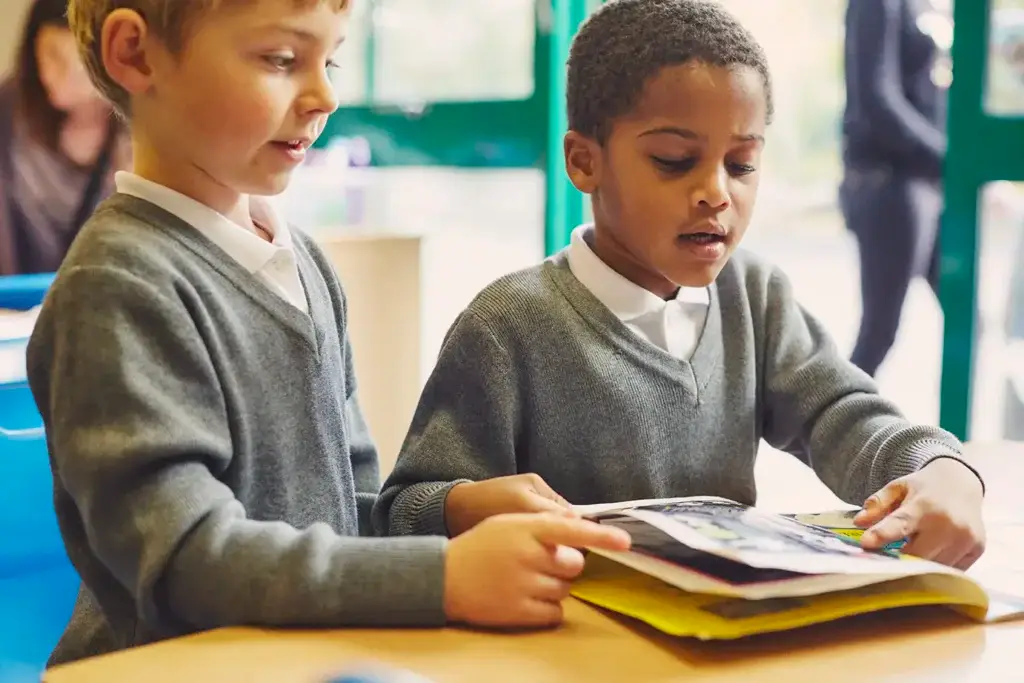
One of the most powerful aspects of oracy is that it democratises learning. Every pupil, regardless of background, benefits from talk-rich classrooms. When talk is used strategically, it levels the playing field: those who struggle with written expression can demonstrate understanding verbally, and those who thrive in discussion can scaffold peers’ learning.
Dialogic, collaborative talk can be particularly potent. The most effective method under the dialogic talk umbrella is exploratory talk, where ideas are explored through sustained back-and-forth discussion. Exploratory talk allows pupils to refine their thinking through questioning, explanation, and reasoning and as a form of collaborative talk, it encourages learners to negotiate meaning, challenge assumptions, and arrive at deeper understanding. Neuroscience supports this: Clark and Dumas (2015) found that when pupils explain ideas aloud, they strengthen neural pathways associated with comprehension and critical thinking, making learning more durable which, in turn, boosts motivation and strengthens neural pathways associated with social interaction and learning.
A Progressive Approach to Oracy
Oracy is not a one-off skill; it must be developed progressively across the school journey. Pupils need experiences that gradually expand their audiences, purposes, and complexity of talk.
- In Year 3, they might present a topic they know well to their peers.
- By Year 6, they could ‘sell’ a product to a panel of visiting officials to showcase persuasive language in front of an unknown audience.
- In Year 11, seminars on thematic literature or scientific concepts encourage analytical and structured argumentation.
- By Year 13, interviews, debates, and presentations prepare pupils for real-world scenarios.
An effective oracy progression ensures pupils develop three intertwined capacities: listening, speaking, and communication adaptability, underpinned by experiences across a range of audiences, purposes, and contexts.
Embedding Dialogic Practice in Classrooms
Many schools, despite good intentions, rely on incidental talk within lessons, where discussion happens only occasionally or superficially. For oracy to flourish, teachers must lead dialogic classrooms intentionally. This means creating a culture where discussion is expected, valued, and scaffolded.
Notably, teachers must become facilitators of talk, often needing to “stand back” at times, allowing pupils to grapple with ideas independently while guiding dialogue subtly. Using sentence stems helps structure talk and encourage deeper thinking. For example:
- “I agree with ___ because…”
- “I would like to build on what ___ said by adding…”
- “Can you clarify what you mean by…?”
We include HERE our free Talk Strategies resources for classroom use aimed to support learners develop effective talk technique using structured language.
Such scaffolds support what Neil Mercer calls ‘interthinking’ (Mercer, Words and Minds pub. 2000), where pupils collaboratively think through problems by verbalising reasoning, challenging ideas, and negotiating understanding. Interthinking is central to oracy because it shows that thinking and talking are intertwined.
Learning About Talk as a Curriculum Focus
Oracy is not only about giving pupils opportunities to speak; it is about learning about language itself. A robust oracy curriculum explicitly teaches how language works, why it varies, and how it shapes identity.
This can be integrated across the school day:
- PSHE lessons: discussing speech diversity and developing social understanding as well as the impact of language on our lives.
- Assemblies and form time: Focusing on key oracy knowledge and studying technique over a range of contexts, text diversity and and the range of languages that influence our own.
- English lessons (including spelling instruction): examining authorial choices, word origins, and rhetorical devices.
For instance, literature provides a lens through which pupils can explore language. Examining dialect in a text or the use of historical language can illuminate how language reflects heritage, social context, and identity. Pupils then learn that Standard English is only one form of English, and that code-switching – adjusting language to suit different contexts – is a conscious skill that needs to be developed.
Learning about talk enriches pupils’ appreciation of language, empowers them to express nuanced ideas, and prepares them to navigate diverse social and professional situations with confidence.
Establishing a Culture of Oracy
Ultimately, the key to effective oracy provision is creating an oracy culture. Schools that prioritise oracy embed it across policies, pedagogy, and practice. This means:
- Leaders champion talk as a core skill that threads through the whole curriculum.
- Teachers plan for structured talk opportunities in every subject.
- Pupils are supported to develop talk for purpose and audience, becoming skilled communicators across a range of contexts.
A strong oracy culture transforms classrooms: pupils learn more effectively, staff engage in reflective teaching practices, and the school community benefits from richer communication. Oracy becomes not a bolt-on skill but a core element of learning, thinking, and social development.
How One Education can help
We can support you to embed excellent oracy practice in your setting that brings about the best outcomes for your pupils. Find out more about our Oracy support packages and the One Education Oracy Award by visiting our website or by contacting our Oracy Award Lead, Alice Pepper alice.pepper@oneeducation.co.uk.