












Read all about oracy, agency and assessment in this collaborative blog by Alice Pepper, One Education and Lauren Kearney, English Speaking Board (International) Ltd.
Oracy is increasingly in the spotlight, rising further up the agenda following the release of the Curriculum and Assessment Review and the revised OFSTED inspection framework. This means that many schools are taking a fresh look at how spoken language fits within their curriculum. The value of oracy is already well established: for learning, wellbeing, and future employment; nevertheless, it can be challenging to know how to give spoken language the status, teaching, and assessment it deserves in order to situate it alongside reading and writing in an equitable way. At One Education, we advocate using a range of experiences and tasks to develop oracy practice throughout pupils’ education. Ensuring that by the end of their schooling, pupils experience speaking to both familiar and unfamiliar audiences and develop expertise across a range of talk modes such as discussion, debate, presentation and performance will ensure their diversity of skill across a range of talk contexts. Equally important are opportunities for exploratory talk: discussions, debates, group problem-solving, and reflective dialogue that nurture active listening, reasoning, and collaborative thinking.
The development of the physical, social-emotional, linguistic and cognitive elements through talk experiences are key to pupils’ development in oracy, not just to be orally versatile but to develop the metacognition and automaticity of adapting to the talk context, recognising the ‘code’ required and tailoring their content and register accordingly. This threads through all three strands of oracy: learning to talk, talking to learn and learning about talk. Ultimately, being reflective as a speaker and planning talk according to the talk goal is vital for all learners to master to be skilled communicators.

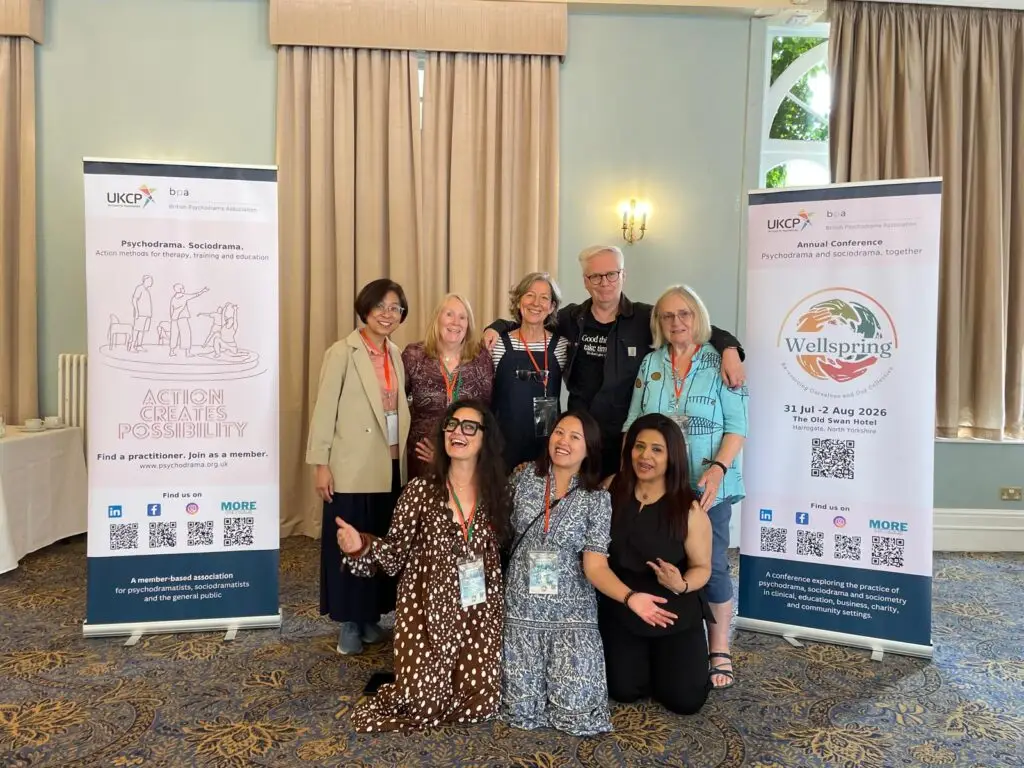
The ESB international qualifications offer pupils a structured programme to prepare and deliver orally across a range of modes to perfect the range of speech disciplines required for education and beyond. Lauren Kearney explains more about the qualifications and the impact they deliver for participants.
At English Speaking Board (International) Ltd, we have had a focus on oracy for over seventy years, designing qualifications which support students’ mastery of speaking for a range of purposes. Throughout our history, our core principles have remained consistent: that learners thrive most when they are given purposeful and real opportunities to speak, to listen, and to be heard. In this blog, we explore three elements we believe can make a real difference to the way oracy is implemented in schools: learner agency, a wide range of purposeful, real-life talk opportunities, and robust, measurable assessment.
Learners as experts: authentic voice and intrapersonal agency
One of the difficulties of assessing oracy is that learners are often positioned as performers of rather than communicators of knowledge. Often, learners are given a topic to research and present on, or a manufactured role-play to engage in, and this is where fear begins to play a role. When children and young people are given the opportunity to be the expert in the room, however, the purpose of speaking shifts. Instead of trying to say the “right” thing in the “right” way, they begin to communicate something that feels more meaningful and personal.
Preparing for an ESB International qualification allows learners to choose what they want to research and talk about. This choice provides an opportunity for what Manyukhina and Wyse (2019) describe as intrapersonal agency – the development of learners’ confidence, motivation, self-belief and sense of control over their own learning and expression.
This sense of ownership allows learners to become the experts, bringing their knowledge, experiences, and passions into the classroom. Making learners the expert creates the conditions for stronger communication to emerge. Structure, clarity and expression develop more naturally when learners feel secure in what they are saying and recognised for who they are.
Real-life talk tasks and the development of interpersonal agency
If learners are to grow as confident speakers, they need opportunities that reflect the reality of communication beyond the classroom. Real-life communication is relational, varied and responsive, and oracy provision should mirror this complexity.
Within current ESB qualifications, learners take part in tasks such as:
- giving a prepared talk on a topic of their choice
- introducing and reciting a poem from memory
- reading aloud a chosen passage with expression
- listening and responding to questions
- asking questions and making comments based on the work of others
- engaging in a 1:1 interview with an adult
- conducting a phone call for a functional purpose e.g. move an appointment
- facilitating and leading a discussion with their peers
A key feature of this is our group-based assessment approach. Learners are assessed in small groups, speaking alongside their peers rather than in isolation. This creates a genuine social context for communication, where listening, responding, building on ideas and supporting one another are all part of the experience.
Robust, measurable assessment that values choice and individuality
At ESB International, our external assessment model offers a consistent and supportive way of recognising spoken language as a formal area of achievement. Trained, standardised assessors observe learners’ communication within a real group context, capturing not only what is said but how it is shaped, expressed and adapted.
Crucially, assessment values the choices learners make in their spoken language. This includes how they structure their ideas, use their voice, express emotion and respond to others. There is no single ‘correct’ way to meet the criteria; instead, the range of ways learners can demonstrate clarity, purpose and expression is actively recognised.
The combination of intrapersonal agency (how learners feel about their own voice) and interpersonal agency (how they engage with others) creates a powerful foundation for communication. Learners do not just become better speakers; they feel more able to advocate for themselves, participate in meaningful dialogue and express their identity.
– Lauren Kearney, Senior Assessor for Oracy, English Speaking Board.
Developing a voice, collaborating with others and gaining a mastery of oracy skills is also one of the key aims of the One Education Oracy Award; to ensure equity through oracy. It is vital that schools and settings create a programme of oracy opportunities for pupils to experience so that they leave education with the tools, experiences and confidence required for the world beyond their schooling. By taking part in focused tasks which develop understanding and cognition around talk in a range of contexts as well as to achieve purposeful talk goals, students will gain the oracy expertise required for their future success.
Our new primary and secondary framework resources developed for the Oracy Award include suggestions for tasks and activities to ensure coverage of opportunity.
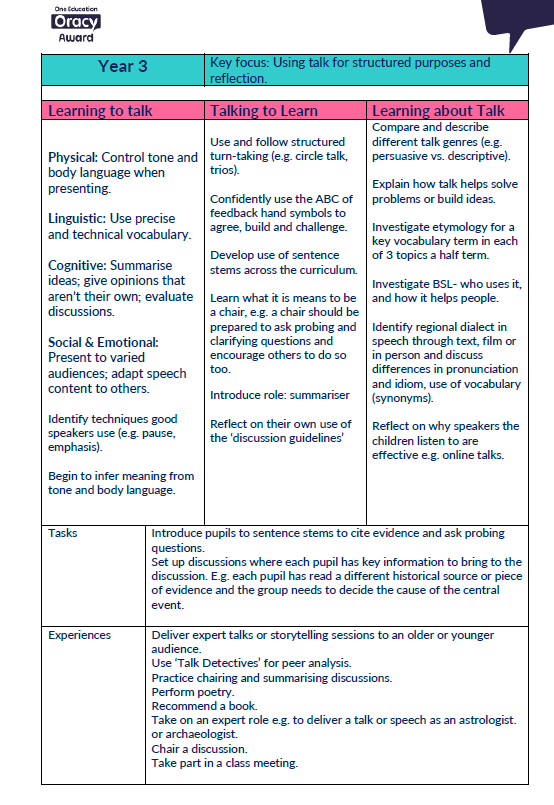
These examples include objectives for each strand of the oracy curriculum. The oracy activities span the three strands of Learning to Talk, Talking to Learn and Learning about Talk to ensure the range of speaking and listening coverage in purposeful contexts which are intended to link to curriculum content.
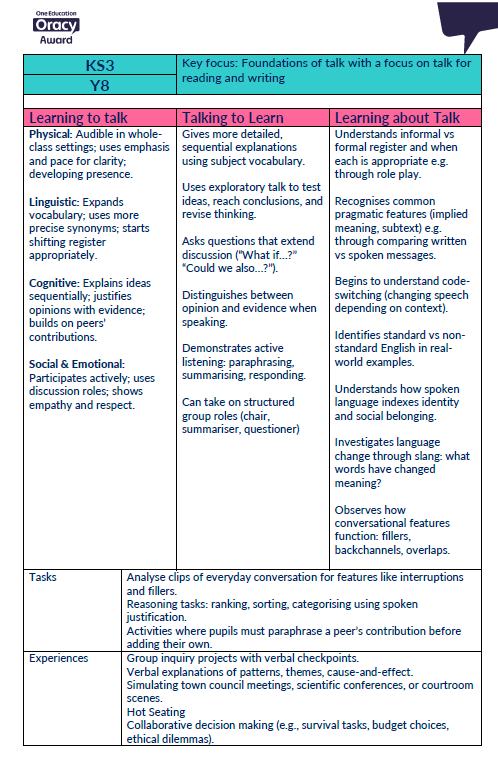
By creating a curriculum where oracy tasks and outcomes are within all curriculum areas alongside providing opportunities focused more high-stakes tasks such as the ESB qualifications and training that comes alongside it, will ensure the high level oracy outcomes our pupils deserve. Together, the One Education Oracy Award objectives and the ESB International qualifications demonstrate how high-quality talk, meaningful choice and purposeful assessment can work in harmony to transform pupils’ communication. By embedding structured oracy at the heart of the curriculum, schools create coherent pathways that develop learners’ confidence, independence and adaptability across a wide range of authentic speaking experiences. When pupils are supported to understand themselves as speakers, to engage thoughtfully with others and to apply their skills in real contexts, oracy becomes far more than a discrete skill set—it becomes a vehicle for equity, agency and lifelong learning. Ultimately, strengthening oracy in this way ensures that every learner has the opportunity, and the right, to be heard.

Find out more about how to lead and implement an effective oracy curriculum in your school or setting, take part in our One Education oracy webinar series. Bookable as separate webinars or at a reduced cost for all three.
This series is designed to help schools strengthen their approach to talk in the classroom. Across the sessions, we’ll explore the three key strands of the One Education Oracy Award – learning to talk, talking to learn, and learning about talk and how to develop a whole-school approach to implementing high-quality oracy.
To find out more about ESB qualifications and how you can get your school or setting involved click here, or get in touch directly at business@esbuk.org. You can also follow ESB on LinkedIn.
Alice is also on Linkedin here, or follow One Education Ltd for more updates.
If you would be interested in one of our One Education Oracy Support packages to guide your oracy progress as a school, or would like to find out more about the One Education Oracy Award, please get in touch with alice.pepper@oneeducation.co.uk to find out more or visit our website.
References
Kearney, L. (2025) ‘Embedding structured oracy in the primary curriculum’. Impact Journal, The Chartered College of Teaching. Available at: https://my.chartered.college/impact_article/embedding-structured-oracy-in-the-primary-curriculum/.
Kearney, L. and Wilson, A. (2023) ‘A unique opportunity in the curriculum for students to have genuine agency over their choices and outcome: A study of the impact on learners of employability-focused externally assessed oracy qualifications’. Impact Journal, The Chartered College of Teaching. Manyukhina, Y. and Wyse, D. (2019) ‘Learner agency and the curriculum: A critical realist perspective’, The Curriculum Journal, 30(3), pp. 223–243.