











Key Stage Two SATs are done and dusted for another year, but while we wait for the results on the 7th July, it’s important to take some time to reflect on the assessments and our practice more widely. Too often, assessments at any age and stage become the driver for school curriculum. This is something we actively have to work against – statutory assessments need to remain a snapshot to check progress and attainment, not be used as a tool for curriculum development. What we can do however, is explore what assessments tell us to give us a window into what best practice in learning can look like in school.
We’ll be delving further into what we can learn from the assessments at KS2 for English at our virtual Learning from Assessment in 2026 courses on the 7th (Reading) and 14th (Writing and GPaS) July. To find out more and to book your place, visit:
Assessment is only useful if we use it to directly impact teaching and learning, so what lessons can we learn from the content of the tests in 2026?
The Grammar, Punctuation and Spelling test for 2026 was reasonably well received, although there was some discussion around the ordering of the questions, with a significant focus on Year 5/6 content early in the paper, whilst some ‘easier’ questions linked to KS1 content came towards the end, preventing less secure pupils from having a go. As usual, some of the spellings chosen were also seen as tricky, with terms like suspicious included. Nevertheless, the test was seen a broadly fair and accessible, similar in challenge to the reading paper.
Grammar, Punctuation and Vocabulary
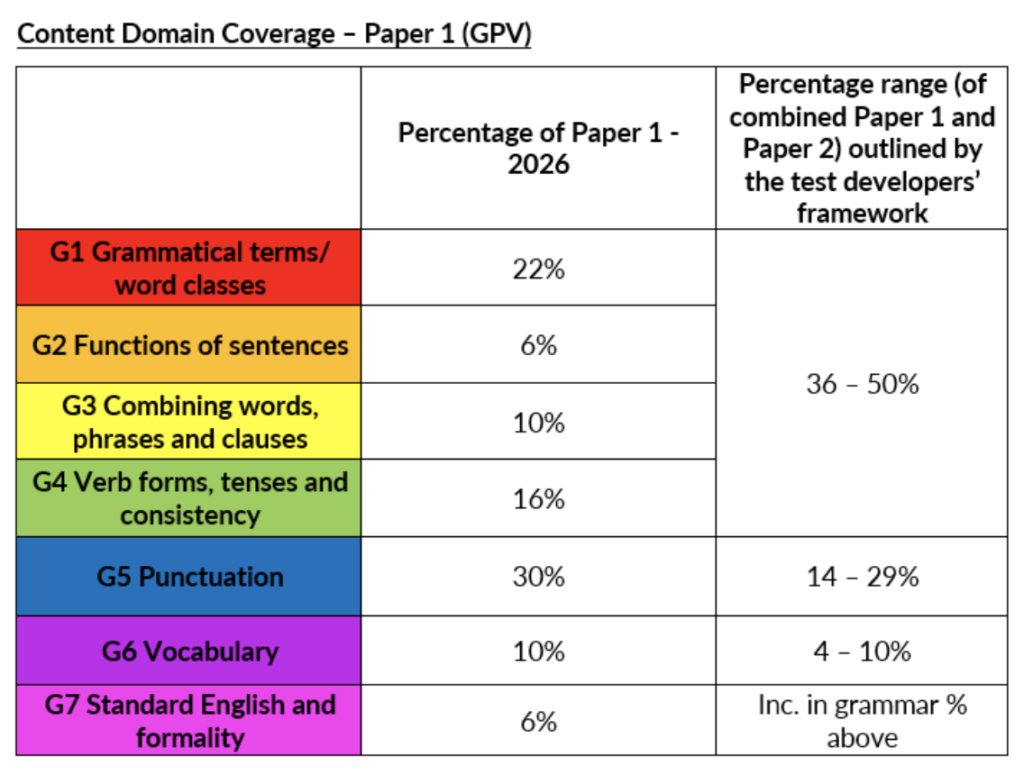
Every year the GPaS assessment includes questions that span the full remit of the National Curriculum English Appendices 1 and 2. In 2026, Paper 1 was mainly focused on grammatical terms, verb forms and punctuation, even exceeding the percentage range outlined in the GPaS Test Development Framework marginally.
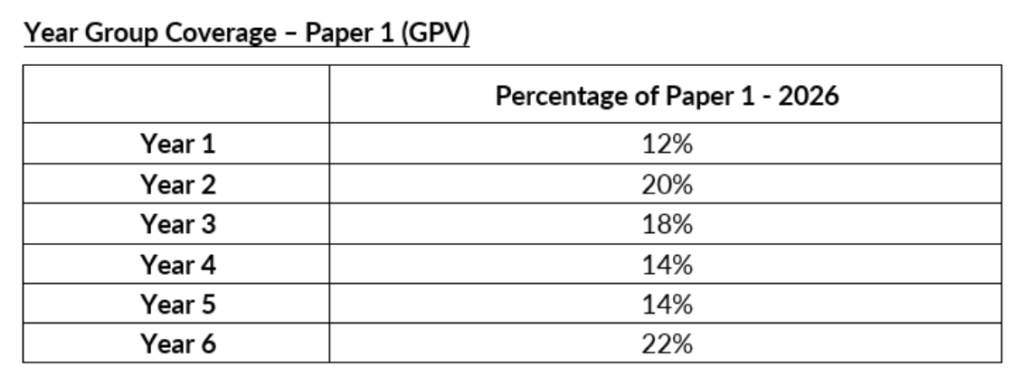
It’s important to remember that these assessments not only assess the Year 6 curriculum, but are an assessment of the whole primary curriculum. As in all years, in Paper 1, children encountered questions focused on curriculum content from across KS1 and KS2, with a relatively steady split across each year group.
Ensuring your grammar teaching is wide ranging and covers each aspect of the National Curriculum is key. However, sometimes we are guilty of getting tunnel vision and only focusing on our own year group content. For grammar and punctuation particularly, we have to meet the children where they are in their learning journey, as the grammar curriculum is cumulative and builds on prior learning. Considering the component knowledge one needs to have to underpin learning first, and then adapting teaching to meet the children on that continuum is crucial.

Although the test covers all of the technical elements of the National Curriculum for English, and contributes to the assessment of writing, it is worth remembering that research shows little correlation between the teaching of de-contextualised, GPaS test style questions and children’s composition. In practice, many more pupils may achieve the expected standard on the GPaS paper than are able to consistently demonstrate it in their independent writing, and care needs to be taken to not prioritise ‘test-style’ questions at the expense of teaching the application of grammar and the craft of writing. Grammar teaching should always be in context and clearly related to the impact of effect of that grammatical or language feature. We need to avoid ‘SPaG spotting’ and instead spend time discussing what that feature does. doesn’t do and what happens when we use or don’t use it – investigating and playing with language.
Key questions to consider in your context:
- How is grammar taught? Is it taught in context through clear modelling?
- Are children given time to explore and experiment with grammar, vocabulary and language?
- Is key content recapped and reviewed? Is it fully embedded before moving on?
- How are gaps in previous learning addressed?
- How is grammar assessed? What’s the impact?
Spelling
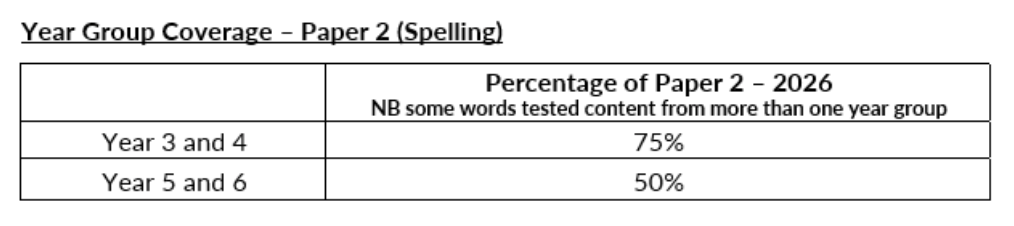
In 2026 for spelling, children were tested on spellings from every year group in KS2, with the majority of spellings focused on LKS2. Whilst not explicitly assessing spelling knowledge from Years 1 and 2, children’s ability to apply their phonics knowledge from these year groups was also crucial to success.
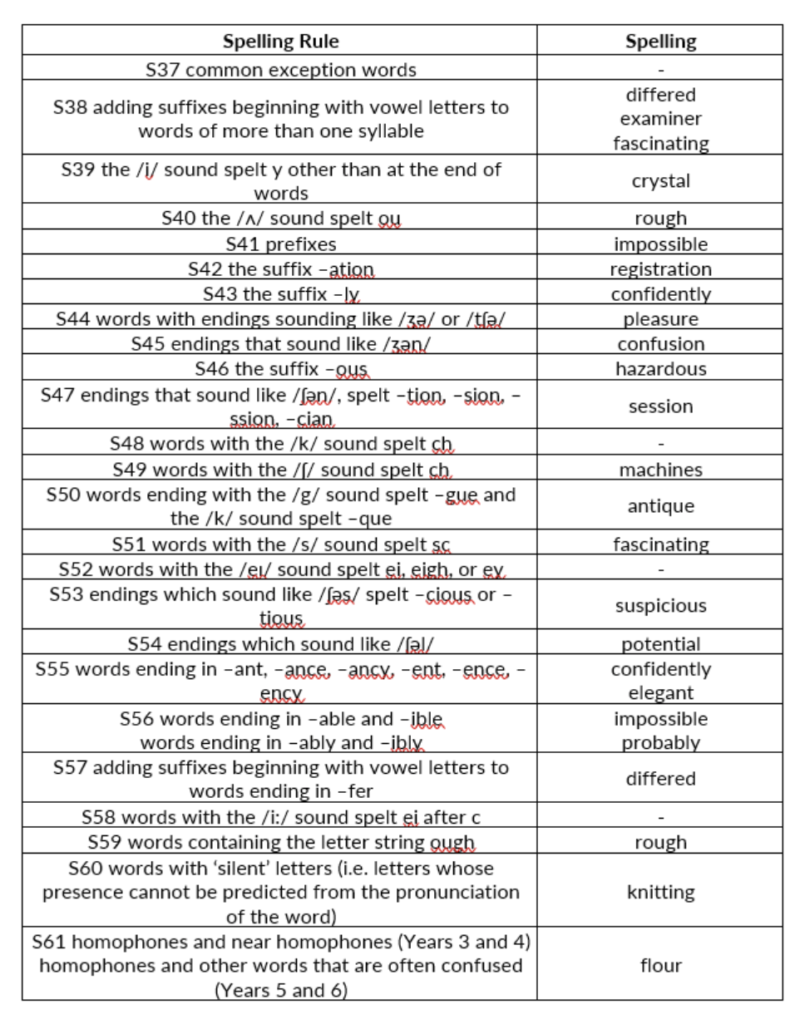
The spelling rules tested in 2024 were as follows:
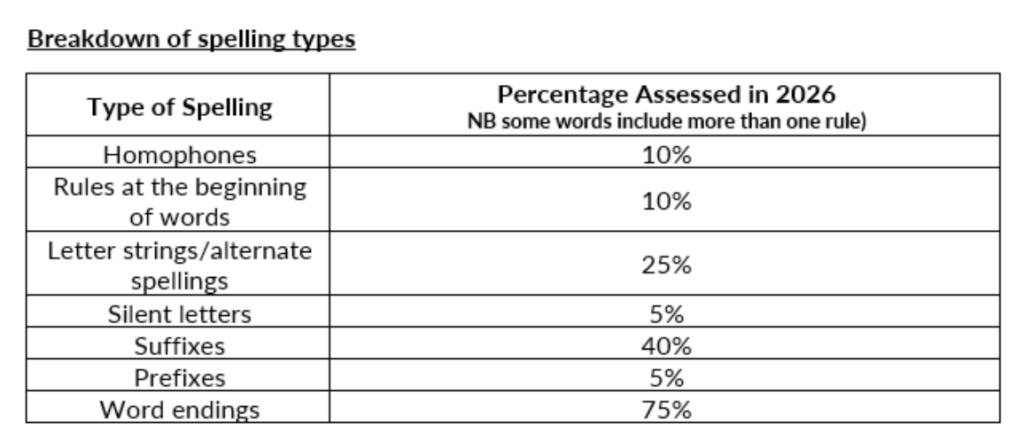
It is also useful to note the placement of the rules within the words assessed:
Having a clear understanding of your children’s gaps in spelling knowledge is key to ensuring they become fluent writers. Although spelling teaching has come on leaps and bounds over the last few years, with many more schools now teaching spelling more consistently, few off-the-shelf schemes build in sufficient time for recap and review of earlier patterns and rules. We need to teach both year group spellings and help all children to catch up on their gaps if we want to build true fluency in transcription.
Diagnostic spelling assessments are one way of assessing which spelling knowledge is missing for classes, groups or individuals. Click here to download a free example diagnostic assessment.
Key questions to consider in your context:
- How is spelling taught? Is it consistent?
- Is dictation used to support pupils to practise and embed spelling learning?
- How are spelling rules and patterns from previous year groups recapped and reviewed?
- How is children’s spelling knowledge assessed? What does this assessment tell you? Are patterns in errors interrogated?
- How are gaps in previous learning addressed?
- Can children apply their spelling learning to their independent writing? Are they fluent in transcription skills appropriate to their year group? How is this fluency prioritised?
What Next?
Of course, the Grammar, Punctuation and Spelling test is just one small part of writing assessment. In our Learning from Assessment in 2026 course, we will also be exploring implications of the 2026 KS2 Writing Moderation cycle and implications for best practice in the teaching of Writing.
We’ll now have to wait to see what threshold is announced on the 7th July, and the number of pupils reaching the expected standard. Even though the pupils being assessed this year are soon to leave primary school and move on to their secondary education, it’s crucial that we take the time to unpick what pupils’ responses tell us, as well as test content. One part of your approach could be to run some Question Level Analysis, being careful not to allow the headlines to skew your judgement. However, also looking at pupils’ scripts is a key part of a secure approach to assessment at any level. By doing this you can unpick exactly what needs your pupils have and correlate this with your plans for practice in the new academic year.
What’s really important is we use assessment information and analysis wisely. It is crucial that we don’t use the analysis of external assessments to plan our curriculums or teach to the test. Instead we should explore the insights it can give us about how successful our provision for English is as a whole and from that, make adaptations to practice that ensure gaps in learning are addressed for all pupils. This is the focus for our ‘Learning from Assessment in 2026: Implications for Teaching and Learning at KS2: Reading‘ course and accompanying Writing and GPaS course, where we’ll delve much deeper into what the assessments tell us, and what they don’t tell us, using this to inform next steps in good practice across the whole key stage.
To download our analysis of the KS2 GPaS SATs paper for 2026 please click here.
If you haven’t caught up already, look out for our companion blog: Learning from Assessment in 2026: KS2 SATs Reading, where you’ll also find our analysis of the KS2 Reading SATs paper.
For more information on how we can support you to develop your approach to the teaching of English, in Year 6 and beyond, please contact our Literacy Team Leader, Laura Buczko at laura.buczko@oneeducation.co.uk