







Key Stage Two SATs are done and dusted for another year, but while we wait for the results on the 7th July, it’s important to take some time to reflect on the assessments and our practice more widely. Too often, assessments at any age and stage become the driver for school curriculum. This is something we actively have to work against – statutory assessments need to remain a snapshot to check progress and attainment, not be used as a tool for curriculum development. What we can do however, is explore what assessments tell us to give us a window into what best practice in learning can look like in school.
We’ll be delving further into what we can learn from the assessments at KS2 for English at our virtual Learning from Assessment in 2026 courses on the 7th (Reading) and 14th (Writing and GPaS) July. To find out more and to book your place, visit:
Assessment is only useful if we use it to directly impact teaching and learning, so what lessons can we learn from the content of the tests in 2026?
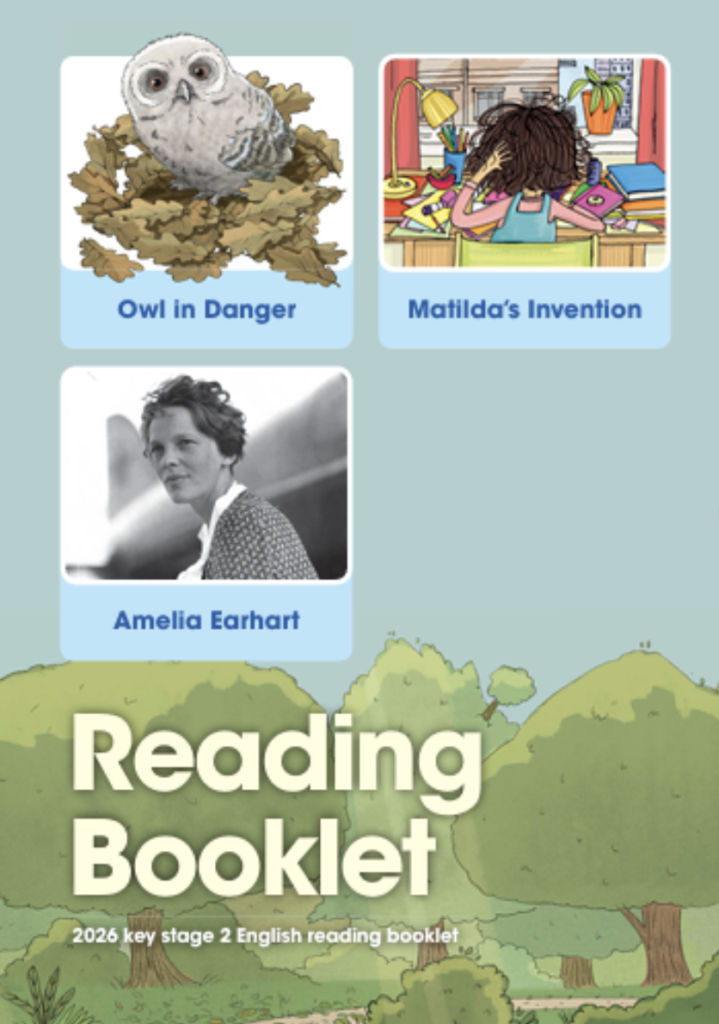
Reactions to the 2026 test have been broadly positive, with teachers and leaders commenting on the test feeling fair, being reasonably accessible and that the texts, on the whole, were interesting and engaging. Unusually, this year, the reading booklet began with two fiction texts, followed by a final non-fiction text. Yet again, no poetry text was included, however we need to be careful not to over interpret this pattern. What else can we learn from the texts used in the assessment this year?
Texts
The first text, Owl in Danger, was a narrative about two children who find an owlet out of its nest and debate about what to do next. With a Lexile level of approximately 750L, this first text was pitched at around Year 5 level. The extract was taken from Owl in the Office by Lucy Daniels, one of the Animal Ark series and its setting and chronology were supportive. The vocabulary and language was largely accessible, though there were some trickier terms including bedraggled and fragile, to contend with. The language and sentence structure was also relatively straightforward; however some children will have struggled with distinguishing between the different speakers.
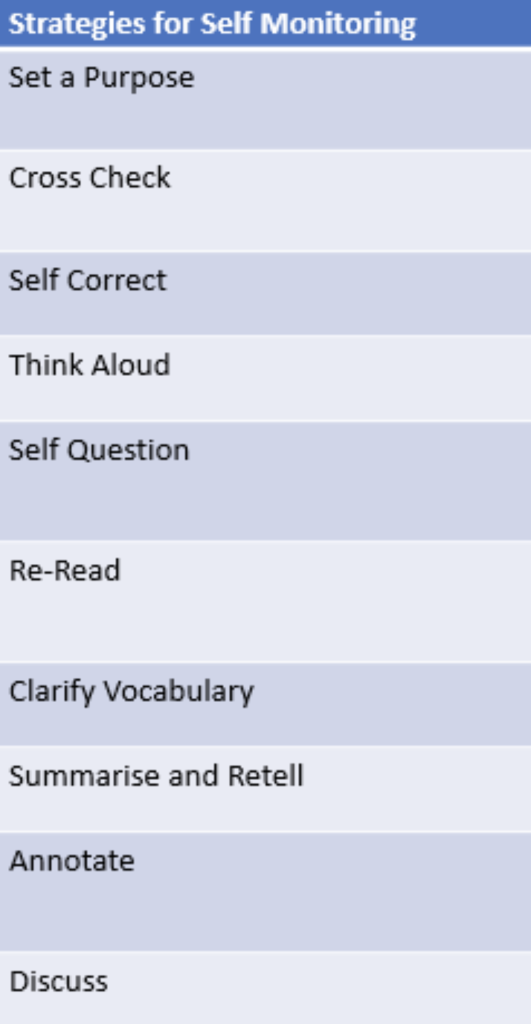
Although book talk and responses to reading should be our priority when teaching reading, it is also important to consider how we can support children to build their own reading strategy bank. Key to understanding this text was the ability to make coherence inferences through recognising the author’s use of pronouns. Teaching children to self-monitor their reading and check their understanding needs to underpin your reading approach, so that children are actively reading every time they read.
Second came Matilda’s Invention, a narrative about Matilda and her love of inventing, taken from The Matilda Effect by Ellie Irving with a Lexile level of approximately 850L, equating to Year 5-6. With an engaging and relatable protagonist and a relatively straightforward conversational style, this text was again reasonably accessible with a clear plot. A mixture of sentence types and mainly familiar vocabulary also supported readers, although there was some use of technical vocabulary, e.g. suspension bridge and links to historical figures which added some complexity.
Although the story had a relatively sequential plot, children needed to be able to read the text closely to note where Matilda switched from narration to directly addressing the reader, as well as to unpick some of the use of hyperbole and humour. Giving children opportunities to close read and unpick texts with modelling and support is crucial and should form a key part of teaching every text.
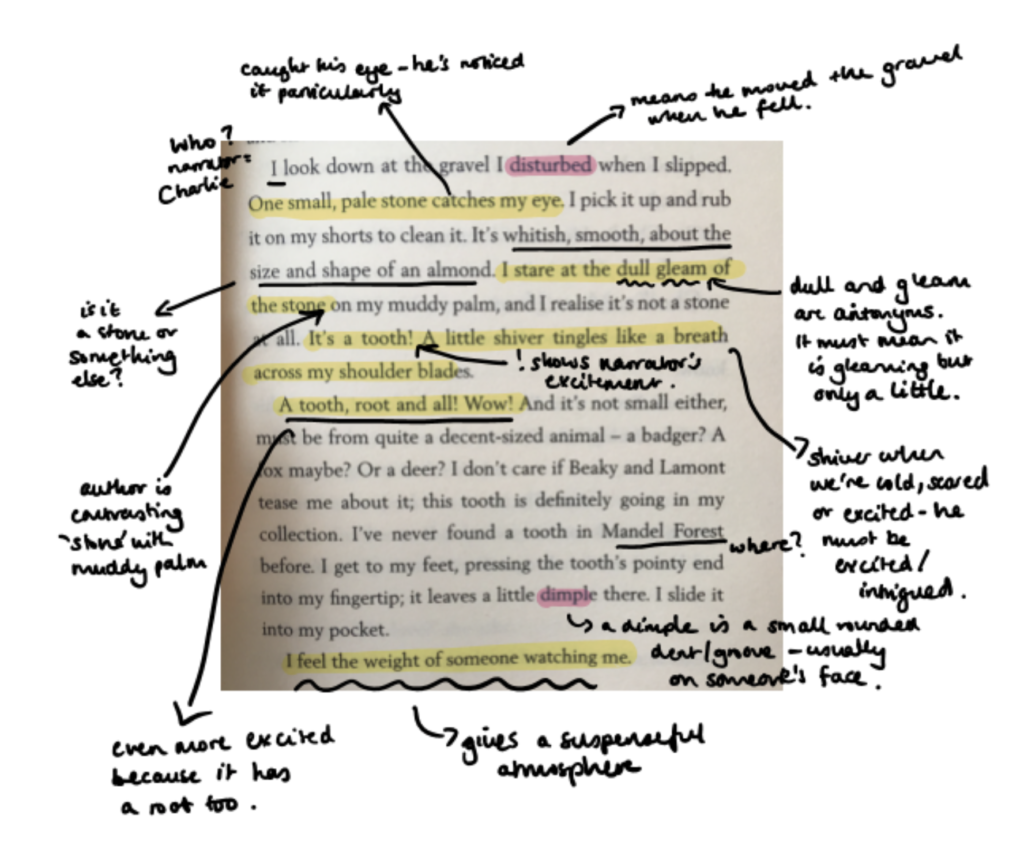
Lastly, the third text, Amelia Earhart was a non-fiction biographical text exploring the life, achievements and disappearance of one of the world’s most famous aviation pioneers. This was the hardest of the three texts to comprehend, with an approximate Lexile level of 980L, which is around Year 6-7. The focus and vocabulary for this text was quire technical, with terms such as pioneering, aviators and fuel capacity. The sentence structure was also more challenging with longer multi-clause sentences throughout.
With a historical setting and biographical focus, children needed to be able to activate their background knowledge to be able to access this text fully with links to History and Geography to grapple with. When reading with children, too often we can jump into reading, without thinking about how to connect the dots for the reader. Making a point to activate background knowledge and known vocabulary, prior to reading, and giving children strategies as to how to do this independently is important. The EEF’s Reading Comprehension house is a useful starting point to considering how the elements of reading, such as vocabulary, are interlinked. However, in my view we also need to consider the foundations under that house too – the background knowledge underpinning it that can make reading comprehension easier.
Now turning to think about the reading diet of your pupils, how often do they encounter non-fiction texts? There needs to be balance to texts that children read at school, including fiction, non-fiction, poetry and plays, yet too often fiction reigns supreme. Building in a range of non-fiction texts to long term planning and reading spines will not only support children to end primary school as expected fluent readers, but also secure their reading longer term. Consider the daily reading you do as an adult: almost all of it is non-fiction.
Key questions to consider in your context:
- Do all children explore a breadth of texts across KS2? Is sufficient time given to fiction, non-fiction, poetry and plays?
- What does reading aloud look like in your school? How many reading aloud texts are non-fiction?
- How is reading prioritised across different subjects through disciplinary literacy?
- How is background knowledge activated to support reading?
- Are pupils used to engaging with texts that have different levels of challenge? Do they have reading resilience? Are texts at the beginning of the year simple enough? Do they increase in difficulty and length as children become more confident?
Fluency
Oftentimes, the focus for Year 6 children is solely on comprehension, however the KS2 SATs are a test of fluency and decoding as much as understanding. In order to reach age-related expectations in Year 6, children must be able to decode and comprehend age-appropriate texts fluently. As a rough measure, this means children should be able to read and understand age-appropriate texts at around 90 words per minute. There is sometimes the temptation to focus entirely on speed, however this can come at a cost in terms of understanding. Children need to build fluency, not speed alone to improve their reading.
The word count of the entire paper (reading booklet and questions) this year was approximately 3069 words, which is slightly higher than in 2025 but roughly similar to 2024. This meant that children had roughly 26 minutes to answer the questions. However, this is based on children reading at a fluent rate of at least 90 words per minute; pupils who read less fluently will consequently have far less time to answer the questions about each text.
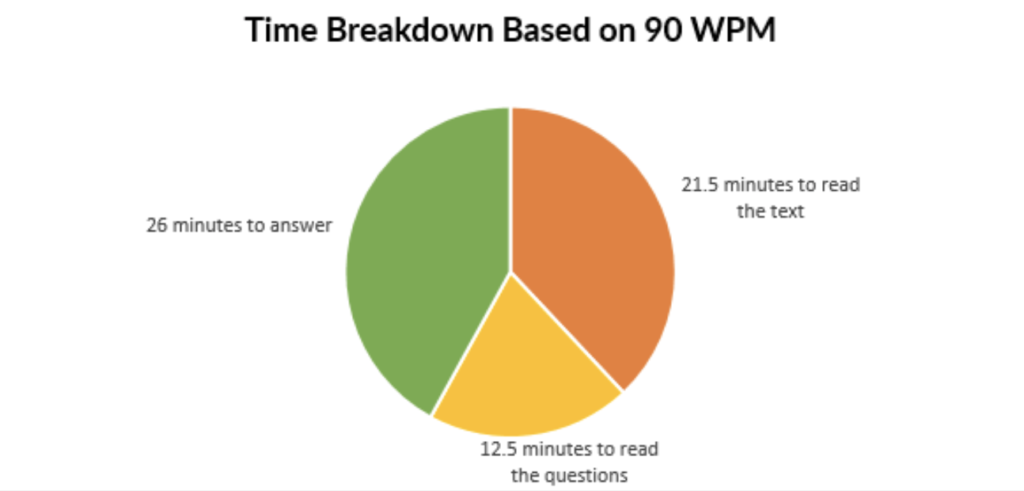
Fluency needs to remain a focus for teaching right the way through a child’s reading journey at school. It isn’t something that should be boxed off in LKS2 or just focused on lower attaining readers, but needs to be a priority for every child in every year group. As texts become more complex, fluency can wane, so we need to think carefully about how best to track and embed fluency right until the end of Year 6.
Key questions to consider in your context:
- How fluent are readers when reading an age appropriate text? How do you know? What does assessment look like?
- How is reading fluency prioritised once children finish your school’s SSP programme?
- For children not reading at 90 words per minute (with an age appropriate text), what additional support is in place? How is it helping them to catch up?
- How often do children hear good role models of reading fluency?
- How long are reading texts? How are children supported to read longer and more complex texts over time?
Strategies
As one would expect, the test assessed children’s reading comprehension using a variety of skills and strategies, with vocabulary knowledge, retrieval and inference the top focuses, followed by summarising. Once again there were no prediction questions, although there was an increase in the number of questions exploring the relationship between content.
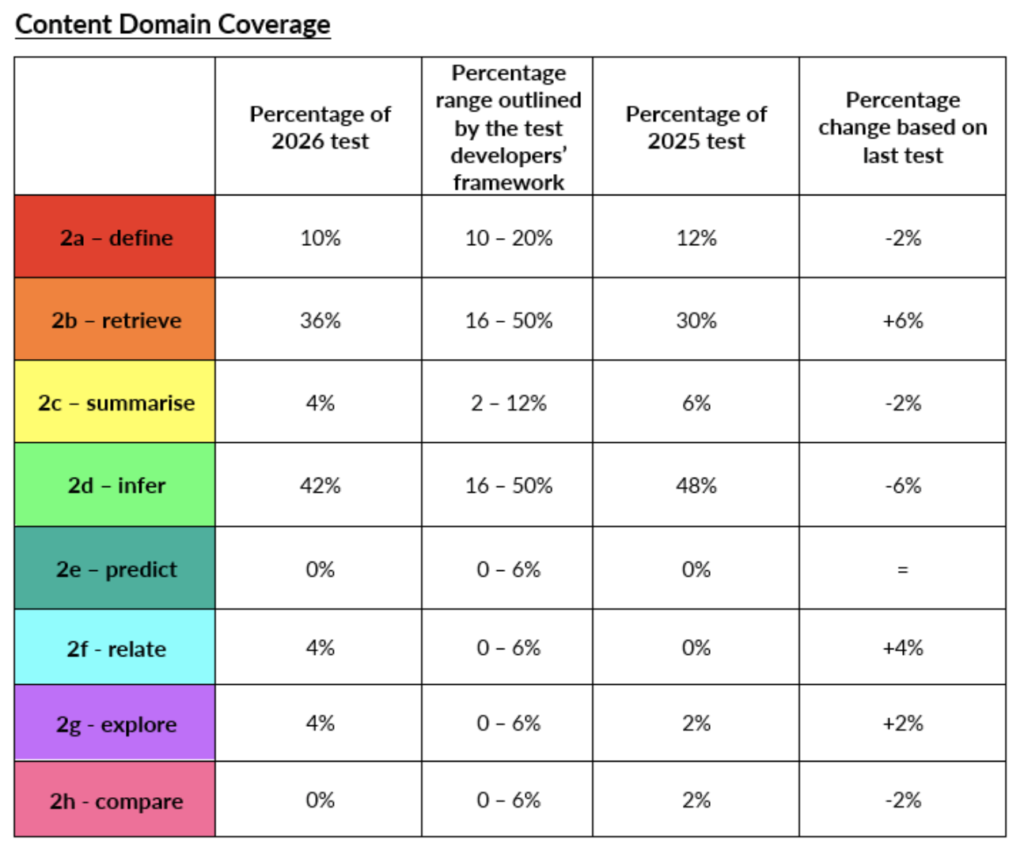
We want the breadth of texts and responses to texts to form the bulk of our reading teaching, however paying attention to children’s reading strategy toolkit is also key. As well as fluency and self-monitoring strategies, children benefit from having some practice for specific strategies for different reading skills or domains. For example, knowing the difference between scanning and skimming, and when to use each, or how to unpick context clues for vocabulary understanding. Our Reading Gems Overviews can support you to identify which strategies might be helpful to model with your pupils. Click here to download our FREE Retrieval strategy overview.
Key questions to consider in your context:
- How is vocabulary taught in school? What strategies do children have to unpick the possible meaning of unknown vocabulary?
- What does book talk look like in your school?
- What opportunities do children have to engage with and respond to texts, allowing them to show understanding across different reading skills and strategies?
- Are children taught strategies for reading, e.g. inference making, summarising texts, creating mental models?
Questions
Question styles were varied across the three parts of the paper, with an expanded focus on ‘write two’ and ‘write three’ as well as more questions which required children to think about the whole text.
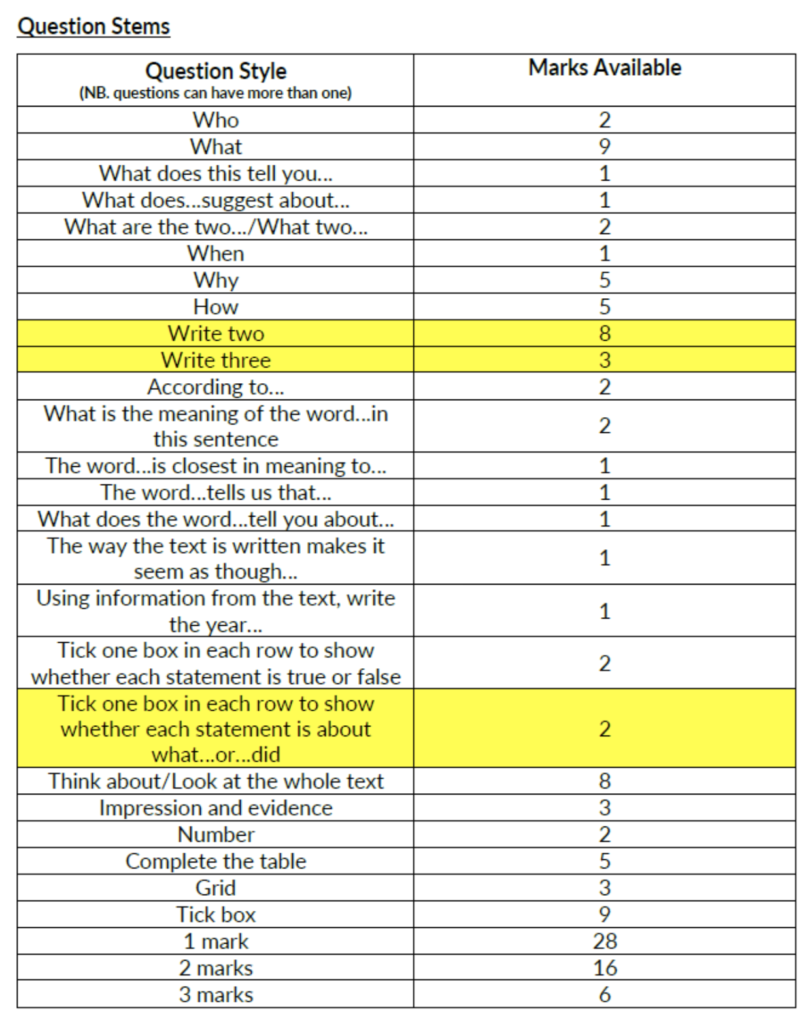
Although questions such as these should not form the main focus for teaching reading, it is important to ensure children have the strategies they need to be able to show their understanding in an assessment situation. Being exposed to a range of verbal and sometimes written questions, modelling response construction and getting feedback on their responses can support children to show what they can do and so does need some attention, perhaps as an assessment point at the end of a unit text or as a chance to independently apply their knowledge of the text towards the end of a lesson.
Key questions to consider in your context:
- Do children understand the language of questioning, particularly basic questions, e.g. who, what, how? Can this do this when asked verbally and when asked to write their response?
- Are children used to being asked, and asking, a range of verbal questions about texts?
- When written comprehension questions are sometimes used for assessment, are a breadth of question stems and styles used?
What Next?
We’ll now have to wait to see what threshold is announced on the 7th July, and the number of pupils reaching the expected standard. Even though the pupils being assessed this year are soon to leave primary school and move on to their secondary education, it’s crucial that we take the time to unpick what pupils’ responses tell us, as well as test content. One part of your approach could be to run some Question Level Analysis, being careful not to allow the headlines to skew your judgement. However, also looking at pupils’ scripts is a key part of a secure approach to assessment at any level. By doing this you can unpick exactly what needs your pupils have and correlate this with your plans for practice in the new academic year.
What’s really important is we use assessment information and analysis wisely. It is crucial that we don’t use the analysis of external assessments to plan our curriculums or teach to the test. Instead we should explore the insights it can give us about how successful our provision for English is as a whole and from that, make adaptations to practice that ensure gaps in learning are addressed for all pupils. This is the focus for our ‘Learning from Assessment in 2026: Implications for Teaching and Learning at KS2: Reading‘ course and accompanying Writing and GPaS course, where we’ll delve much deeper into what the assessments tell us, and what they don’t tell us, using this to inform next steps in good practice across the whole key stage.
To download our analysis of the KS2 Reading SATs for 2026 please click here.
If you haven’t caught up already, look our for our companion blog: Learning from Assessment in 2026: Implications for Teaching Grammar, Punctuation and Spelling, where you’ll also find our analysis of the KS2 GPaS SATs paper.
For more information on how we can support you to develop your approach to the teaching of English, in Year 6 and beyond, please contact our Literacy Team Leader, Laura Buczko at laura.buczko@oneeducation.co.uk