











The start of the new school year means it’s time to get to know your class! As teachers, we know that the more we can understand the nuances, the sparks, the energy and the humour of our class, then the better we can tailor and adapt our teaching to make the most of the next year together.
Teaching a class with EAL children is no different. The latest School Census Data from January 2025 shows that 1.8 million pupils are identified as using EAL. This is a rising percentage and accounts for more than 1 in 5 pupils. Therefore, as a teacher or leader in school, we need to ensure we are welcoming and valuing EAL children in order to create an inclusive environment for all.
How can we create an inclusive environment for EAL children?
The Bell Foundation have created 5 Key Principles to guide school to create effective provision for learners using EAL.
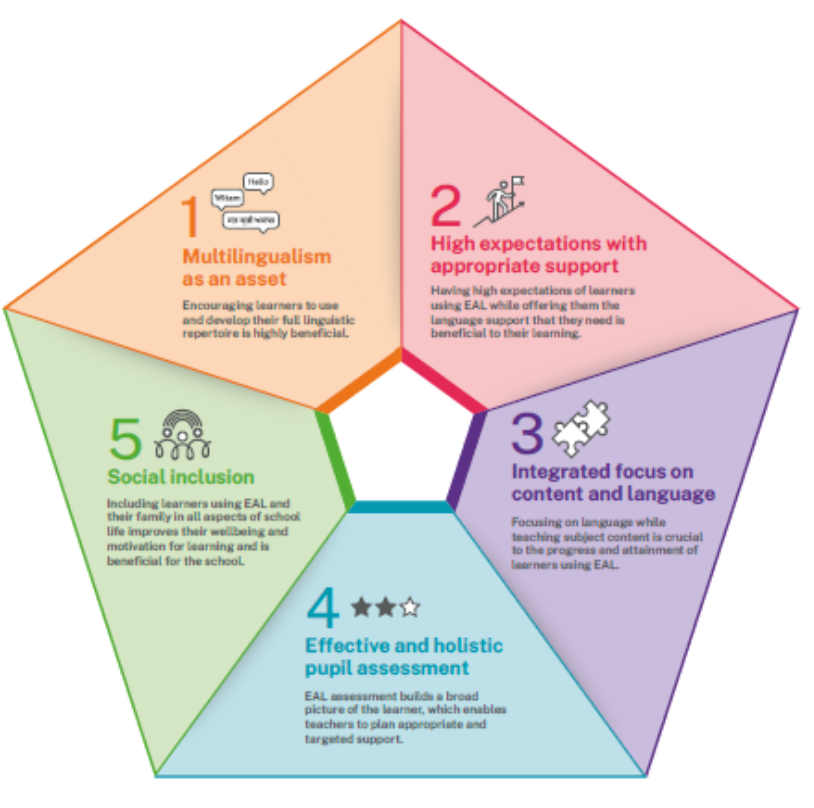
While there is no necessary ‘ranking’ of the best and most effective principle, at this stage in the year – when we are thinking about creating a nurturing and warm welcome – the first and fifth principles are worth spending some time reflecting on.
Of course, all five aspects are crucial to supporting EAL children. Look out for a follow-up blog in the coming weeks, where we will explore the remaining three principles in more depth.
Multilingualism as an Asset
In order to help our EAL children thrive, we want to make sure that they know being able to speak more than one language is an asset and something they should be proud of. The Bell Foundation are clear to note that children should feel valued in all aspects of school life for who they are, and crucially, for the languages that they use, which are a core part of their identity. Therefore, when thinking about the children who have just joined your class, find out about their languages, their background and how you can share the core principle that multilingualism is an asset.
One way to highlight multilingualism as an asset is to create visual displays around the classroom, featuring key vocabulary, greetings, or instructions. This signals to children that every language is valued and welcome. Another approach is language mapping, which involves creating a classroom or school-wide map where children can pin the languages they speak. Again, this reinforces the message that multilingualism is a point of pride, encouraging greater confidence in pupils as well as sparking curiosity amongst their peers.
Engaging with parents and the wider community is another powerful way to showcase multilingualism as a strength. Invite families to share stories, songs, or traditions in their home languages. This helps to build bridges between school and home, underlining the pivotal role that linguistic heritage plays in a child’s education. Similarly, marking special occasions such as International Mother Language Day creates opportunities to showcase languages through performances and creative projects, celebrating the richness of your classroom’s linguistic diversity.
It’s important to ensure that multilingualism isn’t just acknowledged, but actively incorporated into classroom practice. Allow learners to use their full linguistic repertoire to support learning – whether by brainstorming ideas in their first language before writing in English, or discussing concepts with peers in a shared language, or even taking advantage of digital tools to communicate. This enables children to engage with lesson content more deeply and develop confidence in their linguistic abilities.
Ultimately, when we embrace multilingualism as a resource rather than a barrier, we create more inclusive, dynamic, and culturally responsive learning environments. In doing so, we ensure our EAL children not only survive, but truly thrive in their learning.
Social Inclusion
The fifth principle outlined by the Bell Foundation is the importance of Social Inclusion. Feeling part of a community, whether that’s the whole school or the class community, is vital if we are to develop and teach in the most effective way possible.
In his book, ‘Supporting the Wellbeing of Young Children with EAL’, Liam Murphy challenges readers to write down a simple definition of the term ‘holistic’. By doing this, he is emphasising the importance of understanding the child as a whole and not just their academic needs. It is important to consider the mental, physical, social, language and spiritual needs of the child. This ties perfectly into the Bell Foundation’s Social Inclusion principle.
Therefore, complete this challenge yourself:
- What additional information do you currently have about your EAL children beyond their attainment scores?
- Could you currently describe your pupils based on a holistic description?
Focusing on the holistic also means understanding the child’s culture and their family. Murphy notes how it can feel awkward to ask direct questions such as ‘Are you religious?’, therefore he offers a reframing of the question to produce a softer approach that may feel more comfortable such as: We love to celebrate different cultures and different holidays here, are there any traditions you have at home that would help to make your child more comfortable in our setting?
Murphy emphasises that a crucial caveat to eliciting this information is to implement the findings into practice quickly. This means adapting books, dressing up clothes, and celebrations to reflect the information gathered from families. This helps create a stronger feedback loop which will help develop the inclusive environment and show that the information from families has not only been heard but also acted upon.
In terms of day-to-day support in the classroom, consider whether a buddy system is required to support learners. This is particularly important for any new children joining the class this academic year as the aim is always to help them feel settled and welcomed as soon as possible. Don’t worry if the child is quiet in the first few weeks – this is absolutely normal, as it can take a few weeks to feel settled.
Thinking about the child in terms of their holistic development helps when considering interventions that the child may need. Children, like adults, are social and learn best in social environments. Therefore, it is important to balance the academic need of the child and the social need of the child. If a child is removed from the majority of the whole class teaching for interventions, this lowers their opportunities to develop their language and relationship with peers.
“Learners benefit from exposure to rich language, especially when just above their current level.”
D.Sharples “Teaching EAL” (Multilingual Matters, 2021).
Therefore, to help support language development, we want to provide children with enough time in the main classroom so that they receive this benefit and are involved socially and engage in high-quality peer-to-peer interactions.
Next steps
So, when focussing on just the first and fifth principle from the Bell Foundation, what are the next steps in supporting your EAL children?
- Complete a Pupil Profile
This has been created using resources from the Bell Foundation, L. Murphy and D. Sharples. It is a tool to help reflective thinking about the best ways in supporting your pupils.
- Sign up to our Unlocking Language: A Practical EAL Series.
A new course in partnership with The Bell Foundation. This compromises a 7-session, EAL training programme across the academic year designed to build staff confidence, deepen understanding, and provide practical, evidence-informed strategies to support multilingual learners in all settings. Click here to sign up.
For more information on EAL and how we can help support your school, please contact Liz Dwarampudi, Education Consultant at liz.dwarampudi@oneeducation.co.uk